
Naming your initiative to signal action and to deter free riders

We have all been part of a group project in which only a few did the work, while many went along for the ride. Many change initiatives face the same challenge. A few take the risks, raise the difficult points, or frame the opportunities, while many more join in simply because they fear being done in. Or they come for the coffee.

In the early stages of a change initiative, you want to find ways to attract those willing to imagine new possibilities despite imperfect conditions. You want to reduce the risk of people thinking aloud about what can be tried and how problems might be reframed as opportunities to explore. This is hard, if not impossible, if you have group members who are cynical or who believe that some benefactor beyond the group should do something to change the conditions. 

Your first task is to create a safe space for people not only to imagine what is possible but also to harness existing resources, energies, or even lessons from the past to try something different. For now, it may be best to invite a few people personally to join your “thinking-out-loud” session. But it is not possible to keep these ideas hidden. At some point, you must go public. Firstly, trust is not built in secret. Secondly, the fact that something is being tried should inspire others. Lastly, letting others know that people are working on a new initiative might also be attractive to new investors or contributors.

But how to attract the innovators and potential contributors while avoiding the nay-sayers or those entrenched in the way things are now?

One way to do this is to ensure that the name of your initiative signals a journey towards something or an active exploration. The name must indicate that some form of additional effort, a different destination, or some risk is involved. The initiative’s name must be a first filter that attracts innovators and problem solvers, while at the same time creating a barrier for free riders and Status Quo maintainers.

Too many well-designed initiatives to innovate or challenge the status quo get stuck simply because the activity is labelled to sound like a topic that the tradition bearers, pioneers, and the indifferent identify with. A great idea may get stuck because those interested in the Status Quo or in deferring the problem to someone else outnumber those willing to explore alternatives.

People must not be included in the initiative by virtue of their current status, sector, location, profession, or any other generic category that encompasses both those who want to innovate and those who are comfortable with the present, or who have too much invested in the current arrangements. The main criteria for involvement should be your interest in collaborating and your willingness to contribute resources, information or effort.

Once you have the starting group members self-selected and you are moving in a new direction, one can always explore with the group of innovators whether somebody who did not join should be included.

In any case, as your new effort starts to show results, more people will want to jump on the bandwagon in any case.

Let me explain this in the context of some of the work we are currently supporting.

  • Ecosystems are often named by either the core technologies used (e.g. the Digital Animation Ecosystem) or a particular kind of beneficiary (e.g. the Women-in-Engineering Ecosystem). This name opens the initiative to almost everyone who identifies with the keywords it contains.
  • The promotion of adopting new technologies is often named after the technology, not for the kind of change or opportunity it unlocks.
  • The promotion of an area is often named after the location the place, not the kind of innovation or improvement that is being explored.
  • Sector development initiatives are often named after a key input, an existing process, or a key market served.

If you are going to try to get a group of people to try something new, then you should also name your initiative to signal risk-taking, exploring new configurations and opportunities to contribute to something different.

This blog post was originally published on www.mesopartner.com.

How to figure out how technology is changing

In everyday English, technology can refer to a gadget, artefact, know-how, or software application. In contrast to this colloquial understanding, Professor Brian Arthur[1] emphasises the importance of a broader understanding in which technology is seen as a means to harness natural phenomena and arrange processes to produce something or achieve a specific purpose.

To substantiate this broader understanding of technology, Brian Arthur[2] provides three different definitions of technology:

  1. The most basic definition is that technology (in a singular sense) is a means to fulfill a human purpose by harnessing natural phenomena. For some technologies, this purpose may be explicit; for others, it may be vague. As a means, a technology may be a method, process or device. A technology does something, it executes a purpose. It could be simple (a roller bearing) or complicated (a wavelength division multiplexer). It could be material, like an engine, or nonmaterial, like a digital compression algorithm. Some technologies combine with other technologies into technology architectures, which may form part of even larger technological systems. For example, an engine is part of a car, which is part of a more extensive transport system. However, an engine itself consists of an assembly of complementary technologies. Generating energy with a photovoltaic panel, using MS Teams/Slack/WhatsApp to coordinate a team or designing with computer-aided design (CAD) software are examples of technologies at this level.
  2. A second definition is plural: technology as an assemblage of related practices and components. This covers technologies such as electronics or biotechnology that are collections or toolboxes of individual technologies and practices. These assemblages can also be called bodies of technology as they harness related phenomena. Examples are the catalogue of ways alternative energy can be generated or how different sensors and control systems can be deployed in a manufacturing plant. When solving a problem, it is possible to choose between alternatives from this toolbox or different toolboxes.
  3. A third definition is technology as the entire collection of devices and engineering practices available to a society. As new technologies become available, new institutions, norms, and supporting technologies are needed to make them feasible. In other words, the economy expresses its chosen technologies.

Arthur argues that we need these meanings because each category of technology comes into being, and evolves, differently (Arthur, 2009:29).

As technologies are absorbed or deployed, complementary technologies, including regulations, institutions, and norms, are deployed or developed. This is a process of structural deepening, where old technologies are increasingly substituted with new combinations of technologies and institutions, and industries, markets, and institutions adjust or reorganise.

These three definitions are shown in Table 1. Changes in the first category are relatively easy and fast, becoming progressively more difficult in the second and third categories. The third category is marked by an ongoing change process often carried over generations or extended periods.

Table 1: Definitions of technology

Definition of technologyExamplesRelevance to tracking tech change
Technology as a method, process or device.CAD software, Enterprise resource planning (ERP), Industrial robotics, recycling.Identifying technologies that are affecting companies, or that require coordination beyond a single firm.
Technology as an assemblage of practices and components – toolboxes.Digitalisation of manufacturing, greening of manufacturing, supply chain integration.Identifying technologies that require many simultaneous changes in one or many organisations. Structural deepening would require coordination between industries and enabling institutions.
Technology as the entire collection of devices and practices available or the economy as an expression of its technologies.The societal preference for greener solutions, a growing sensitivity towards the effects of mankind on nature, a new awareness of healthier living.The structural change processes that shape what the economy is evolving towards as technologies, institutions and markets co-evolve. New institutions create the stepping stones to the future, while old institutions try to maintain the past.

Tracking technological change at the first level is almost futile. This is where companies, or perhaps individuals in companies, procure or design a new solution that can solve a specific problem. This is hard to measure or track. People also describe their actions differently. I once met a CEO who called this R&D, while the financial director called it “investment” and the production manager called it “replacing something that we could no longer fix”.

As more and more people invest in a given technology, an assemblage or toolbox starts to develop. As time goes by, more and more technologies in this toolbox can connect with each other as standards and common sub-modules are developed. Alternative technologies that approach the same problem or draw from the same principles will emerge. The result is that companies can choose different configurations of related technologies within the same industry or market. However, it is also possible that companies can choose from different toolboxes in the same industry. Service providers that can help companies choose alternatives or implement solutions enter the marketplace. Enabling institutions that provide technological services, shared infrastructure, or education programmes may emerge around the technological toolboxes. A new technology language has formed. From a measurement perspective, tracking this kind of change in economic statistics is tricky because the changes are still mainly within companies, and economic statistics tend to lump all of the companies in a sector together. The implication is that while the first level of technological change is too detailed, the second level may be too generic.

One point is worth expanding further. Even if a new technological assemblage is available and well supported, some companies or industries might be unable to reach it. This is mainly because the new competencies required might be too far from what they have in place, and adopting these new competencies would require a completely new business model. These companies might actively resist and advocate against the new technological paradigm, but resistance might simply delay the inevitable.

At the third level of technology, the society and the core technological arrangements that make it distinct needs to be considered. At this level, it is not only about the technologies, but also the web of enabling institutions, social norms and markets that shapes the everyday choices of consumers, investors, businesses and the government. For instance, you could compare the public transport options in the Netherlands with those in South Africa and describe the differences in technological terms. At this level, it is again easy to identify the technologies, but it is hard to figure out how to replicate the outcomes or the pathways that led to a certain outcome.

[1] Arthur, W.B. 2015. Complexity and the economy. Oxford, New York: Oxford University Press.

[2] Arthur, W.B. 2009. The nature of technology: what it is and how it evolvesNew York: Free Press.

This blog was first published on the TIPS Technological Change and Innovation System Observatory website.

How institutions, technologies and companies co-evolve

This is the fourth post in this series about economic evolution. In this post, I will look at the co-evolution between companies and the broader institutional environment they form part of.

Towards the end of the 2nd blog, I mentioned that the design spaces within firms (and organisations) interact with different design spaces beyond their boundaries. The available “technology” modules within any organisation, private or public, interact with and are shaped by technology the modules available in the institutional landscape. The technology in the preceding sentence should be understood as “knowing how to do or achieve something specific consistently”. For example, think of the trust system needed for two companies to transact with each other. Perhaps they rely on the social institution of social relations. This worked for most economies for a long time. But with increasingly sophisticated products and services and also the more impersonal nature of many transactions, contracts and their enforcement through a legal system is increasingly important. To further make impersonal transactions smoother, standards, performance criteria and branding are all social institutions that have evolved to enable transactions.

These institutions, including the norms and the organisations that provide related goods and services, evolve with the economic transactions they enable. In some cases, the institutions lead the evolution by providing the economy with new knowledge modules or services. In other cases, unmet demand might lead to an institutional response. Yet in another case, policymakers might design policies to shape the institutional offerings or the demand patterns.

The broader institutions and economic activity co-evolve.

I want to take this further by focusing on the meso space and how this space co-evolves with industries, locations or communities.

The meso space is a design space where interventions are designed to address the persistent patterns in the economy. Most microeconomic transactions occur via markets, hierarchies or networks, and each of these forms of allocation have strengths and weaknesses. All three can fail. When a particular kind of failure persists, this can be called a market failure, management failure (for hierarchies), government failure (in the case of public services failing), coordination failures or systemic failures. The meso space is where stakeholders intentionally intervene to address or respond to persistent failures.

Because it is sometimes not helpful to use labels like market or government or systemic failures, we often describe these patterns as “patterns of underperformance”. These are the patterns we often see when we look closely at an industry, value chain, location or national economy.

Some meso interventions may be targeted at a particular industry, a technology, a region or a specific pattern. In contrast, others may target whole policy areas like industrial, technology, trade or locational policies. While most meso interventions are supposedly intended to deal with negative or problematic patterns, there is no reason that meso interventions can also be designed to leverage positive characteristics. That is exactly what many tourism or investment promotion strategies aim to do.

Meso interventions might be a policy, project, programme, service, or organisation. Sometimes an existing organisation might launch a new service or provide additional functions to address a particular pattern of underperformance in the economy. This, in turn, might result from a particular ministry deciding to create a policy to address a particular issue, like deciding to invest in an incubator to develop particular solutions the company might be interested in. I know this might sound unclear, but when a policy or strategy is specific in its focus, we describe it as a meso instrument. In contrast, macro policies and strategies are more generic and are not specific to an industry, technology or location.

The public sector is a dominant actor in the meso space. However, in most countries, the public sector does not act like one stakeholder. There are different government departments and publicly funded agencies, at different levels, all with different jurisdictions or mandates. Just like coordination failures can occur in the private sector, coordination failures within different public functions can paralyse a country, industry or location.

However, not all meso policies and interventions are about the public sector trying to be the benevolent private sector supporter. Companies can also design policies that shape the economy around them. For instance, a large manufacturer might have policies to develop their supplier networks, to make the location where they are based more attractive, or to support particular public interests. Not-for-profit or non-governmental organisations can also have development policies to address particular economic patterns. So meso policies and programmes can be designed or implemented by the public, private or civil sectors.

While some economic development practitioners are often biased in favour of addressing market failures, the meso space must often also address government and other systemic issues. For instance, the meso space is often critical to designing or implementing programmes to reduce inequality, provide more effective public goods, reduce coordination problems, maintain and expand critical physical and digital infrastructure and address other social priorities.

Suppose a persistent pattern of decline plays out in a location or an industry over time. For instance, let us imagine that the city centre and its key economic activities are in decline. It is unlikely that this pattern of decline can be addressed by only the public sector implementing a few projects. Most likely, the pattern can only be arrested by mobilising many different public, private and civil organisations and then pursuing projects together for extended periods. Interventions aimed only at the private sector are unlikely to work by themselves, as renewal and investment in public organisations, civil and social infrastructure would mostly likely also be required. The location will change as the economic activities of enterprises and the supporting institutions co-evolve. In most cases, this is a process that takes time.

This example illustrates how industries and institutions co-evolve. As the city centre declines, social institutions and networks might also decline. At the same time, new informal economic activities might arise in the place, but this might lead to an acceleration in the decline of formal economic activities. Renewal in public, private and civil organisations might be needed to reverse this trend. At the same time, investments in public infrastructure and attracting private investment are needed. These kinds of initiatives will shape the incentive landscape for investors, individuals and entrepreneurs, just as the kinds of investors, individuals and entrepreneurs might play a role in deciding where to start or what to do.

It is impossible to fix persistent patterns of underperformance in the private sector through the private sector alone. This is at the heart of systemic change: the recognition that firms and their meso landscape of interventions, programmes and organisations co-evolve. Sometimes we start with the firms and then try to invigorate the meso landscape. At other times, we may start with the meso landscape and try to make it more resilient, innovative or valuable to the private sector, the community or the location. But we also have to think both of the micro level where transactions take place via markets, networks and hierarchies, as well as the meso landscape where incentives, investments and coordination takes place. Any systemic intervention would typically involve coordinating the development efforts of the public, private and civil sectors over extended periods.

The challenge is that co-evolutions are not designed ex-ante, although it is possible to catalyse changes in the public and the private sector if there is enough willpower and incentives for change. Every small change creates further opportunities for change by making knowledge or technology modules available. Any idea or modules that become available in the economy, even if it was meant for a specific purpose, becomes part of the substrate of ideas that others can use in new combinations to innovate or transact. This may lead to a further changes in public policies, or to further changes in the institutional landscape, which in turn may lead to additional services or technologies becoming available to the economy.

This is how industries, institutions (both norms and organisations), technologies and locations co-evolve. They contribute knowledge modules or functions to the economy, that others can combine with to create value. And so it goes on.

If you think of the context where you are working, can you see examples where changes in the private sector (performance) lead to changes in the meso landscape or the other way around? Where did new or adapted services from the public meso programmes shape a location, industry or technology? Can you think of any unintended consequences or benefits, in other words, that was not designed intentionally but happened because of preceding changes?

Alternatively, where did changes in the private sector result in adaptation or changes in the public sector?

Lastly, can you think of examples where a civil or not-for-profit organisation’s behaviour (or interventions) resulted in public and private sector changes? How did the system co-evolve as a result?

You are welcome to share your thoughts in the comments below. Or just continue sending your comments to me by email or social media. I value your comments and suggestions.

Image credit: Image created by DALLE on 22 February 2023. The prompt was to create a drawing showing the relationship between urban planning and universities.

The modules that evolve

This is the third post in this series about economic evolution. In this post, I want to focus more on the modules that the evolutionary algorithm act upon that I mentioned in the previous post.

Ideas are the most fluffy evolutionary material that spreads between people and organisations. These ideas spread via formal means (like education, formal communications, management decisions or regulations) but also via less formal means like the media, stories, people moving between places and social networks. We pick up ideas as we move around in society, and often we combine these ideas with our own to create completely new idea combinations. I always ask people I interview where they got their ideas for innovations from, and I have heard the most amazing stories of how they took an idea developed in a completely different context and made it work in their own situation.

Tracking how ideas spread in society is tricky, partially because we cannot always remember where we heard or saw something that triggered a thought.

In the first post, I explained that Nelson and Winter (1982:14) preferred to use “routines” instead of “ideas” in their theory as the material that the evolutionary algorithm act upon. Routines are relatively stable ways of arranging physical and social technologies to perform certain functions. Even if they can come about in an arbitrary form, organisations tend to replicate routines internally, and other organisations also copy and adapt routines that appear to work well.

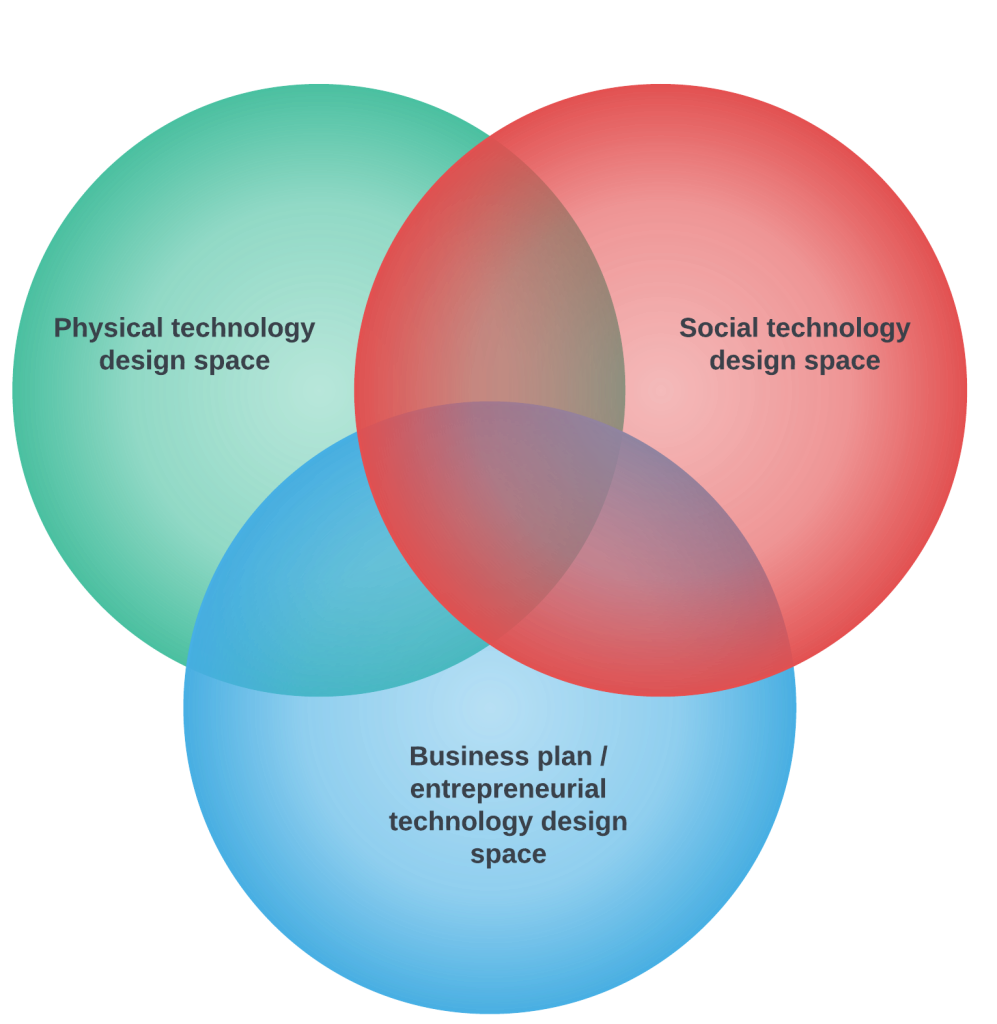
Eric Beinhocker (see the 2nd post) argues for using “modules” as the primary material on which the evolutionary algorithm acts. He agrees with the co-evolution between physical and social technologies but adds that there is a third design space, namely business plans.

“A module is a component of a business plan that has provided in the past, or could provide in the future, a basis for differential selection between business in a competitive environment.” A module is made up of configurations of routines from the physical, social and business plan design spaces.

Beinhocker, 2007:283

Continuous decisions about the composition of these modules must be made in any organisation or company. These routines and modules can be pretty unstructured, but the theory holds that the better-performing modules will be replicated within and beyond the organisation. In contrast, the less-efficient modules or routines will become obsolete when replicated less. However, even inefficient or unproductive modules can persist due to stubbornness, sunk costs, pride or ignorance.

A challenge we face is that the many internal marketplaces (within organisations) where different concepts or module formulations are pitched against each other do not work effectively. In addition, companies relying on inefficient module configurations can still thrive in uncompetitive marketplaces because the markets cannot select better-performing alternatives.

Over the years, I responded to this issue through the instigating innovation series and my teaching at various business schools.

Those organisations that constantly develop or search for new modules or tinker with their existing modules because of anticipated changes in the broader environment can be described as having dynamic capabilities. Dynamic capabilities cannot be bought, it is built through the intentional behaviour of entrepreneurs, managers and employees. David Teece is one of my favourite scholars studying dynamic capabilities, and here is his definition:

Dynamic Capabilities are the firm’s ability to integrate, build, and reconfigure internal and external resources/competences to address and shape rapidly changing business environments. 

Teece et al., 1997, 1990

Teece must often repeat building dynamic capabilities is about achieving abnormal results over the long term. The capabilities part is about the investments in abilities, skills, routines and relationships that are enduring AND that are distinct from what competitors may be doing. The dynamic part refers to the ability to adapt and proactively create market conditions that favour the company. It is about an internal culture of change, experimentation and recognising what works (and what does not work). Why I took this detour is that we need to find ways to foster dynamic capabilities in developing countries in both the public and the private sectors. We have too few organisations actively trying to create new modules that are then adapted based on how they perform in the marketplace.

Back to the main thread. Investments in modules create path dependency, especially when all the investments are along a certain trajectory. In the software and services sectors, companies can change direction faster than in the manufacturing or public sectors. This is mainly due to the way fixed capital is invested in plant, equipment and infrastructure. Once committed to a specific configuration of modules, it may cost a lot of money to change direction.

Whereas routines can often be observed and replicated between companies or contexts, modules are often harder to observe and copy. For example, we can visit a factory and see some physical and social technologies arranged in routines. We can observe how raw material, processes, people and workflows are organised on the factory floor. However, the modular knowledge units combining physical, social and business plans are harder to observe or measure. The hidden parts include the internal incentive structure to innovate and resolve problems, the past learning about what did not work and should never be attempted again, etc., how the factory is connected to suppliers, clients and headquarters, and so on. Some parts of the modules are harder to observe because they weave together past decisions, strategies, funding mechanisms, and future expectations using combinations of physical and social technologies. The machine standing there or how people work together is just the visible tip of the module (or configuration of modules).

The irony is that even management may not realise how much tacit knowledge is involved in the logic that weaves the many different modules combined in a single unit of an enterprise in the modern economy.

From an innovation perspective, there is something else to note about how these modules are created, adapted and disseminated in economic system. The ability to identify, absorb, create and deploy these modules is cumulative. Think of lego bricks. The more modules a specific company has access to or has tried before, the more variations it can create, and the more creative solutions it can select to try in the marketplace.

When this happens over many companies in the economy, markets and users can select from more variety, and better ideas are replicated and amplified in the economy. We know from the research by Cesar Hidalgo, Ricardo Hausmann and the Centre for International Development at Harvard, that these winning knowledge modules can be mapped in the Productspace. (I have a hidden section on my blog site where I have documented some of my experiments and visualisations with this approach – you can access it here).

The experience of selecting combinations or transferring modules to other business areas is cumulative. Companies building modules drawing on different or technological knowledge are better positioned to create entirely new innovative architectures because they can draw on modules from divergent knowledge domains. In contrast, companies that can only manage knowledge modules drawing on narrow knowledge domains are more likely to become specialists. The narrower the range of modules, the higher the risk of being disrupted by other competitors that can build modules on a wider front.

It is not only companies and public organisations that build up these modules. Industries can build modules. Universities play a key role in introducing recent or reliable modules into society. Some modules are described in sufficient detail that can spread via blueprints, technical documentation or software code. Members of online communities can together develop knowledge modules in a distributed way. Just think of the power of Linux or other forms of open-source software that is developed in a distributed way.

Modules can also be accumulated in a society, like the knowledge of how to organise a certain kind of festival, or the modules accumulated through dealing with certain phenomena from the environment. When people change jobs or move from a workplace, they carry with them some understanding of the modules and their sub-routines with them. However, turning some of these modules into a business unit, product or process might require investment in developing the missing business plan areas.

In some locations, office parks or regions, knowledge about certain modules may be developed or may flow more easily over organisational boundaries. Of course, this process may be fostered by developing unique public (or private) infrastructure and through social networks.

I’ll go ahead and conclude. Entrepreneurs, managers, investors and public officials have to intentionally decide where to build modules in their organisations. These modules will typically combine elements from physical and social technology design spaces with business plans. Modules will evolve as they are selected by the organisation (management) and by the market. These modules are cumulative, those that have access to more can also create more variations. Those who draw their modules together from more divergent knowledge domains may have a long-term advantage over those who specialise in building capabilities in a narrower field. Dynamic capabilities are about intentionally investing in capabilities, and continuously evaluating, adjusting and refining existing modules with new ideas from beyond the organisation. Not all the modules originate in a firm, some are present in a community, or a network or are drawn from other companies or contexts. This is easier in some places than in others.

Some questions to explore in your own context:

  • In the industries or domains that you work in, what are the modules that you can identify?
  • How are they changing?
  • Who are the pioneers that are accumulating modules from divergent knowledge domains?
  • How do they compare to those mainly focused on developing modules in a narrower field?
  • Which public and private organisations have built up dynamic capabilities? In other words, they are constantly reflecting on their performance, and constantly working on building capabilities based on their understanding of their own situation in relation to changes in the broader context. How are these organisations managed, and how does their performance compare to more conventional organisations?
  • How are the accumulation and adaptation of modules fostered or promoted in certain areas, knowledge domains or industries?

Please share your thoughts in the comments, or drop me an email.

Image credit

The image at the top of this blog post was created by DALL-E of OpenAI. asked DALLE to create a picture of a topographical landscape with valleys and peaks.

PS.

Here in South Africa, we are all developing modules of how to cope with electricity blackouts (Our government calls it “load-shedding”, which is an excellent way of describing institutionalised incompetence).

Sources:

Beinhocker, E.D. 2007.  The origin of wealth. Evolution, complexity, and radical remaking of economics`. London: Random House.

Teece, D.J., Pisano, G. and Shuen, A. 1997.  Dynamic capabilities and strategic management. Strategic Management Journal,  pp. 509-533.

Teece, D.J. 2019.  A capability theory of the firm: An economics and (strategic) management perspective. New Zealand Economic Papers, 53.

Further reading:

If you have access to journal databases, you should also look up the fantastic work of Giovani Dosi, and also Richard R Nelson and B.A Lundvall.

Updated on 5 March 2023 with minor corrections

How technologies evolve

In my previous post, I introduced the general evolutionary algorithm of variety creation, selection and amplification.

I intentionally remained vague about what the evolutionary algorithm act upon by referring to “ideas”. In this post I will be more specific about what kind of ideas evolution acts on.

Nelson and Winter (1982) argued that the material that evolution acts upon are formal and informal routines:

“ We use this term to include characteristics of firms that range from well-specified technical routines for producing things, through procedures for hiring and firing, ordering new inventory, or stepping up production of items in high demand, to policies regarding investment, research and development, advertising, business strategy about product diversification and overseas investment. In our evolutionary theory, these routines play the role that genes play in biological evolutionary theory

(Nelson and Winter, 1982:14)

These routines could emerge through serendipity or they could be the result of the creative efforts of individuals or teams. They could originate in isolation, but very often they are combinations of old and new, or combinations of internal and external ideas tried in a local context. These routines could be arranged around particular equipment or processes, or they could be norms about how people in a workplace treat each other.

These routines become part of the technology available to the firm. Good ideas that seem to work better than alternative arrangements typically spread between organisations and teams through imitation, social networks or the movement of people. Sometimes ideas are spread by word of mouth, other times through text or the media, and in some cases through mimicking or copying (or reverse engineering). Sometimes a confluence of factors makes the same ideas or routines emerge in many different organisations at the same time. Think back to how we all had to figure out how to get our work done during the Covid lockdowns.

Within organisations, the ideas and the routines that are selected are chosen by how they contribute to the objectives of the organisation. For most companies, the contribution of these routines to profitability is important, but that is not the only criteria. External and internal incentives will shape what is deemed the selection and retention criteria. I have visited enough companies to know that profitability is not the only criteria. Within companies, there are marketplaces for ideas. If somebody makes an suggestion about an improvement or adjustment management and peers might select those ideas, or they may be rejected. But let me not digress.

Ultimately, all the routines and ideas that a company create, adapt and combine (through its internal idea markets) result in products, services and offerings that are either selected or rejected by external markets.

But we know that organisations cannot only achieve their objectives with routines. I again turn to Nelson and Winter (1982) who argued that there is a co-evolution between two different kinds of technological spaces:

  • Physical technologies are what we often think of as technology. It is the artefacts, equipment, infrastructure and even code that are used to perform a function or to harness natural phenomena to achieve a specific outcome. These technologies are methods and processes for transforming matter, energy and information from one state into another in pursuit of a particular outcome. A physical technology is not only an artefact, it also includes the designs, instructions and code needed to make it, maintain and use it. Physical technologies are typically modular and often interdependent on other physical technologies. For instance, my smartphone depends on other technologies to function like a mobile network and the electricity distribution system.
  • Social technologies are methods, designs and arrangements for organising people in pursuit of a goal or objective. Social technologies smooth the way for information to be exchanged, priorities to be set, or unexpected situations to be dealt with. Social technologies enable (or disable) learning and adapting to changes in the environment. Organising people into a hierarchy, creating and enforcing regulations or arranging marketplaces are all social technologies. Like physical technologies, social technologies are modular and cumulative. Each new knowledge module or routine that is created opens up new further opportunities for a variety of new creations.

This co-evolution within an organisation also co-evolves with the physical and social technology spaces beyond the organisation. For instance, the social technologies beyond the firm like the regulatory frameworks, the incentives in the economy to innovate, or the tolerance of failure or uncertainty will influence the physical and social technologies available within the firm.

In the same way, the physical technologies beyond the firm, like the infrastructure, access to scarce equipment or expertise or access to required inputs will also shape the choices of physical and social technologies available to the leadership.

The point is that the social and physical technologies harnessed in any organisation is not isolated from the social and physical technologies in the environment around the firm. Ideas cross over the permeable boundaries of the organisation.

Of course, we expect innovative leaders to create internal environments that are much more conducive than external environments around their firms. However, we know how hard it is to get this right. In many developing countries, leaders of companies (but also government departments) have to contend with a wide range of challenges that make the deployment of more recent physical and social technologies very hard – largely because of a lack of diversity and depth in the social and physical technologies beyond their organisation. I will come back to this in a moment.

In 2006, Eric Beinhocker published The Origin of Wealth: Evolution, Complexity, and the Radical Remaking of Economics. It is one of the books that have influenced my thinking the most. In his book, Beinhocker reframes the social and physical spaces introduced by Nelson and Winter as “design spaces” within which entrepreneurs and leaders have to make choices based on their resources, their capabilities, the external environment and the markets they are in.

Beinhocker also introduces a third design space that he calls the Business Plan design space. This is where entrepreneurs, leaders and innovators have to meld physical and social technologies together under a strategy, and then create routines that express the resulting design into the economic world. This strategy must include ways to raise finance, attract talent, set priorities, allocate resources and create an internal environment that is typically distinct from the external environment. From my experience of working with innovative teams, I know that this business plan space could also be described as an “entrepreneurial technology” because. Just like the other two design spaces, entrepreneurial technologies are created by combining knowledge modules, insights, talent, networks and competencies into new configurations.

So now we have three design spaces that co-evolve in a given organisation. There are physical technologies, social technologies and business plans/entrepreneurial technologies. At the same time, this co-evolution in the organisation also co-evolves with the design spaces beyond the firm. The inside of the organisation exchanges genetic material with the design spaces in the immediate and even more distant design spaces.

To tie this back to the evolutionary algorithm, within each of these three design spaces, variety is created, selections are made, and “good” ideas are amplified. A “good” idea meets the requirements of the internal idea markets within organisations and eventually must also meet the fitness criteria in the marketplace.

Innovation is not only about designing better physical technologies, we also need to foster innovation in the other design spaces within and beyond firms. It is very hard (I would go as far as claiming it is impossible) to successfully innovate in one design space without affecting the innovation potential in the other design spaces.

At the same time, development practitioners must pay attention to how the design spaces within organisations affect or interact with the design spaces beyond firms. This is where the co-evolution of companies, public organisations, universities and other social organisations and the physical infrastructure co-evolve.

Sources:

Beinhocker, E.D. 2007.  The origin of wealth. Evolution, complexity, and the radical remaking of economics. London: Random House.

Nelson, R.R. and Winter, S.G. 1982.  An Evolutionary Theory of Economic Change. Cambridge, MA: Belknap Press of Harvard University Press.

Evolution in the economy

Economic evolution is often a topic in conversations with the teams I am coaching and the leaders I advise. It is a simple idea to explain, yet it allows for a much deeper exploration of why and how economies and organisations change. Even leaders without a background in economics or innovation can see the role they play in promoting innovation and economic development.

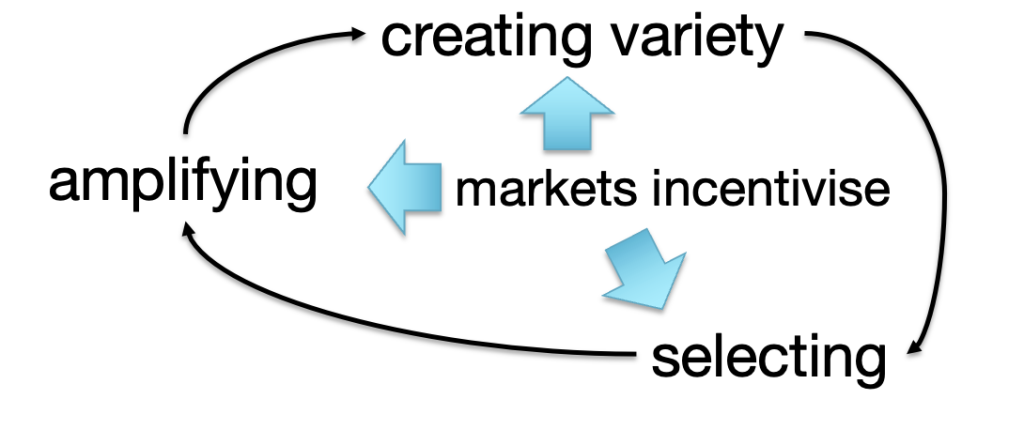
Evolution is a general-purpose and potent algorithm for finding innovative solutions to complex problems. It describes a naturally unfolding process in the economy that plays out at different levels as people, individually and collectively, search for and try new ideas or modifications of what they already know. At its core, evolution is an iterative process of creating variety and selecting designs that are fit for purpose and then amplifying these by adapting resource flows. While in nature, fitness is determined by the environment, in economies, fitness can be intentionally influenced by human actors.

The idea that economies evolve continuously is not new. The term “evolutionary economics” was coined by Thorstein Veblen (1857-1929) already in 1898. Earlier, Karl Marx and Adam Smith raised issues that are now seen as part of the evolutionary economics school. Joseph Schumpeter’s theories of economic development had a strong evolutionary perspective. Possibly the Schumpetarian idea that is best known beyond economics is his suggestion that entrepreneurs introduce innovations that creatively destroy the equilibrium created by the predominant arrangements. Much later, Richard R Nelson and Sidney G Winter’s book An Evolutionary Theory of Economic Change (1982) was a seminal work that marked a renaissance of evolutionary economics.

Below is a simple illustration of the evolutionary algorithm.

The evolutionary algorithm works as follows:

  • An innovator or a team creates some variation based on existing ideas. The new idea is often created by recombining what is already known (knowledge and technology is cumulative) with some new insights. Or perhaps they figure out the idea based on their understanding of a given situation (experience is also cumulative). It may even be that the variation is created through serendipity. The critical point is that the variety of possible solutions or stock of ideas increases, irrespective of whether there is currently demand for any of these ideas. For the variation stage to be complete, the idea must either be recognised by the innovator as worthy of further pursuit or knowledge of the variation must spread to others.
  • A few pioneering buyers, managers, investors, or other innovators then select an idea because it can address a need, or solve a problem, or plugs a gap in a given context. Selection implies that resources, attention or access to complimentary knowledge or networks are made available, leading to the concept’s further development. Choosing an idea that is different and unproven is a risk, but the people making the selection somehow recognise the idea’s potential or the limitations of existing alternatives. Innovative ideas are often further developed because they are selected. My late business partner Jorg Meyer-Stamer constantly reminded me “that technologies become efficient because they are chosen; technologies are hardly chosen because they are already efficient”. As the idea attracts more resources, funds, interest, talent and pioneering buyers, it becomes easier for others to select it as the concept is refined. At this point, other innovators may enter and create more complimentary variety, which makes selection even more likely as the ecosystem of related and complimentary solutions becomes more established.
  • At a certain point, the idea becomes amplified in the economy or the system beyond the ideas or designs of the original innovators. Where those doing the selection in the previous phase were taking a risk, in the amplification stage the risks are much lower as the innovative idea is understood better, is more credible and has more support.

This evolutionary algorithm plays out in the marketplace and is fuelled by incentives that shapes each stage. It also plays out within organisations where different ideas compete for resources.

There are ways that we can shape the incentives in all three phases of the algorithm.

  • We can figure out what incentives dampen variety creation or which incentives can be amplified to encourage learning about and exploring possible alternative arrangements.
  • We can explore how we can tilt selection incentives away from innovations that are less desirable towards more desirable solutions.
  • We can explore how good ideas that have already been selected (and thus developed) can be amplified.

I know that the incentives are often understood to be financial. But remember that recognition, being able to contribute, using one’s talent or simply solving a puzzle are also important social incentives. In the same way, fear of failure or ridicule, not having the resources needed, or not having the time or the permission to solve a problem are incentives that hamper innovation.

I want to end this post with just a provocative question. The institutions in our economies and the rules/cultures in our organisations are already shaping the algorithm. What innovations and alternatives are the algorithms in your system incentivising, selecting and amplifying? I would love to hear your reflection on this question.

If you do not want to post it in the comments, then send me an email or reach me on twitter.

Credits: The ideas in this post are inspired by many conversations with Marcus Jenal over the last ten years. In 2015, we had the privilege of deep diving into evolutionary thinking and its applications to economic development in a project funded by the BEAM Exchange. The ideas we have explored together have shaped my view of organisations, markets and how societies evolve.

Different kinds of technology dissemination

In many of the projects where I work, we face the challenge of gaining access to publicly funded resources that the private sector finds hard to reach. These technological resources could be in the form of scarce equipment, specialists or even in the form of codified or tacit knowledge. Often, the private sector is not even aware of the technological resources in their location or country.

I often describe three kinds of technology dissemination:

  • Technology development, which is usually project based and involves the development of very specific technological solutions
  • Technology transfer, which is usually based on a contract between the provider and the recipient that specifies pre-conditions, conditions and which equipment, processes and in some cases expertise will be transferred to the recipient
  • Technology extension, which is usually more interactive in nature. A knowledge holder, like a university department, research lab or enterprise support centre, extends their resources to private enterprises in a complementary way.

In my experience of working on the gap between public technological infrastructure and the needs of the enterprises, each of the three forms of technological dissemination works in some contexts and fall short in others.

  • Policymakers and public funders often prefer technology development because it leverages other scientific infrastructure investments at research organisations and universities. From a demand perspective, it is usually only those companies that have sufficient in-house expertise to develop a specification or that can afford to commission a research or development project with a research organisation that can benefit from this approach. I have only come across a handfull of small companies that have been able to commision technology development projects like this. In most cases, the founders of these enterprises had deep expertise in the technological domain, their internal processes, materials and the markets. I am thinking of one case where a small engineering company specilasing in advanced optics commissioned a research project to develop a new control interface for an aircraft.
  • Public bureaucrats often like technology transfer because it leverages research outputs at universities and research labs. Technology transfer requires that careful attention is paid to intellectual property and that recipients are able to absorb and leverage the technology they are gaining access to. I typically try to avoid this kind of work because I have often found that there are huge gaps between how public researchers and private investors value intelectual property. But I also know of many instances where a technology was developed in a university and then transferred to private enterprises. In my experience, there is a huge gap between what researchers in universities and public research organisations work on, and what small enterprises trying to carve out a niche in a smaller domestic market needs.

In my opinion, the importance of both technology development and technology transfer programmes is often over-rated in developing countries.

At the same time, the value of technology extension is often under-rated. Out of concerns that valuable intellectual property might leak out, many researchers, academics or other officials cannot provide assistance or advice to the private sector. While I understand this concern, in my experience, many enterprises are actually searching for somebody to point them in the right direction – they are not always asking for specific technical solutions that would infringe on intellectual property regulations.

Technology extension involves services like:

  • Demonstrating how certain (scarce) technologies work, or showing how scientific and engineering principles can be appled to real world problems
  • Advising companies on how they can improve or optimise their current processes
  • Providing technical problem solving, analytical or diagnostic services
  • Providing access to scarce equipment, software (like design or modelling software) and access to scarce expertise.

What makes technology extension more difficult is that the advice provided must fit the enterprise’s context and capability. For instance, while companies can pay to get their products tested or certified, very few companies have access to a lab or technology centre where they can get design feedback to make their product more compliant or more economical to produce. At the same time, many universities and public research organisations can provide a basic analysis and design feedback service.

A challenge for the private sector is that public research organisations are often like labyrinths. It is hard to know where the expertise, capabilities, or excellence lies in buildings or behind closed doors. Often you cannot even get into these buildings without an invitation and, in some cases, security clearance. Nevertheless, I love wandering the corridors of these organisations and seeing what technologists are working on. Often there are prototypes, half-dismantled instruments or posters adorning the corridors. The people working there can tell the most amazing stories of how they had to solve a problem, make up for a missing bit, or how they discovered that X could be substituted for Y. When I ask them who in the rest of the world knows what they are doing, I am often met with a shrug, and a “nobody is really interested in this”.

When I ask technologists, scientists and engineers in public research organisations who can most benefit from their genius, I am often told that ex-students, former colleagues and their alumni are often the most valuable customers and sources of inspiration. This seems consistent with the notion that the best form of technology transfer is through the mobility of people. It might imply that I have to introduce “technology transfer through human mobility” as a fourth kind of dissemination.

Image credit: The image at the top of this blog is from an optics lab at the National Metrology Institute of South Africa (NMISA). I took the picture while touring their facilities in March 2020, just a few days before the strict lockdown was announced in South Africa.

Series: Promoting innovation systems praxis in Africa

This year there have been several series of events celebrating the centenary of Christopher Freeman, one of the founding fathers of the study of innovation systems. The different events highlighted many older ideas that are still relevant while pondering how some new ideas might play out into the future.

These events provided the perfect opportunity to read up on many of the essential publications created in the Innovation Systems field in the last 40 years. Many of the ideas developed by these scholars have had a profound impact on my praxis. In the next few posts, I will highlight some of the insights that I have gained from this series of events.

During a recent event, the 3rd “Putting Africa First” panel discussion based on the excellent book by the same name edited by Bengt-Åke Lundvall, Mammo Muchie and Peter Gammeltoft, Prof Mammo Muchie invited me to share some thoughts from the perspective of an innovation systems practitioners.

The remainder of this post expands one of the points I shared during the event about the role of innovation systems practitioners in Africa.

There is too much focus on technological and scientific knowledge and not enough emphasis on learning and innovating in social technologies.”

I am not arguing that we invest less in strengthening scientific research in Africa. Scientific research should continue in areas where Africa face unique or pressing challenges. There are many knowledge domains where learning primarily takes place through scientific research. Examples are healthcare, water management, drought management, etc. that are very important in Africa but are not attractive to international research efforts.

However, we must admit that strengthening scientific research capacity is more exclusive; it involves fewer people, costs more, and takes longer to show results. Moreover, this kind of knowledge accumulation is driven by scientists, engineers, technologists and professional management.

Instead, we have to invest more effort into learning. As practitioners, we must mobilise industries, academics, innovators, and policymakers to learn about problems or opportunities they can explore together in their local or regional context.

In many African Innovation Systems, I believe that this kind of knowledge accumulation through learning-by-doing involves a different set of actors. The attention shifts from universities and supporting organisations towards firms and industries, where most learning-by-doing takes place. Scientists, engineers from academia and other supporting organisations can still play a valuable role here, but the emphasis is different. The mode is also different. Learning-by-doing is a social process. To be effective, it must be inclusive, transparent and accessible to a broader stakeholder network.

Whereas in science management we try to manage risk, in learning-by-doing we try to reduce the risks of trying something new, often involving somebody or knowledge from beyond the organisation.

The role of the innovation systems practitioner is also different. Our function is to enable learning, enable knowledge exchange, joint problem-solving and adaptation of institutional mandates. We often have to overcome coordination failures that constrain investment or reduce the search costs of finding technological expertise or solutions available in the system – irrespective of whether the capability resides in the public or the private sectors. We must often connect decision-makers from different spheres of society, fragmented institutions, divergent knowledge domains, and capabilities around a theme or a topic that matters to an industry.

So, for example, I often take individuals from universities or other supporting organisations to go and visit companies, factories or farms. Or I take entrepreneurs and their staff to go and visit research labs or other technical organisations.

There are two challenges that I have to overcome when I work with technology and education institutions that want to have a more meaningful impact on the innovation system:

  • Firstly, academics, engineers, and policymakers must not see the companies they want to reach as beneficiaries of their wisdom. Nor should they see companies and the technological choices they make as subjects in a research project. I have to help these institutions listen and carefully observe how companies make investment, recruitment or technological decisions.
  • Secondly, technological and educational institutions often have low credibility with or relevance to the private sector. Or worse, institutions like university research centres, research labs, and other specialised organisations may even look down on the private sector.

To get a social learning process going within a firm, or between firms, or even more importantly, between firms and their supporting institutions, I have to find something that different people have in common. In my experience, it seems like it is easier to get companies to work together on problems that are too difficult for individual companies to solve by themselves. Perhaps this is the case because it is easier to quantify the value of a potential solution. It seems much harder to build trust around an opportunity where different stakeholders are worried that others derive more benefits from the process than they are.

I received this image via a Whatsapp message and could not figure out the origins of the photo. The rabbit and the tortoise reminds me of the two modes of learning.

Untangling digitisation, digitalisation and digital transformation

I was recently invited by the Reconomy Programme and the Helvetas working group on Market Systems Development to address practitioners working on economic development in the Balkan region. I was specifically asked to untangle the concepts of digitisation, digitalisation and digital transformation in the context of international development cooperation.

The remainder of this post are the notes that I prepared for this call.

We are increasingly using the words digitisation and digitalisation to refer to certain kinds of economic development and changes to how work is done. These words are often used incorrectly as synonyms to refer to the increased use of software and other electronic gadgetry in everyday life. Every now and then the term digital transformation is also used.

Even though these words sound and look very similar, they are different concepts that are all somehow related. Let me try to explain what these three concepts are about.

Digitisation is the process of converting analogue information into digital information. An example of digitisation is when you convert your old vinyl records to MP3 format, or when you scan your old, printed photos so that you can store them in digital format on your computer. 

Digitisation has slowly crept into our lives over the past several decades. It started with measuring changes in natural phenomena, for instance measuring speed, distance, temperature, vibration, time or altitude. Analog information was simply converted into data points represented by blinking warning lights, alarm bells and bright red digits. Slowly the focus shifted to using digital instructions to control mechanical objects. Consider how vehicle dashboards and instrument panels of aircraft have changed over the past thirty years. 

The digitising process often combines mechanical and electrical/electronic systems, in other words, it combines different knowledge and technology domains into an integrated solution.  As more diverse knowledge domains were integrated, so the reliance on processors and logical operations increased. Initially coding was limited to logic programming of chips, but over time the complexity of coding has increased as the cost and size of chips came down, while the processing power increased. 

Digitalisation is different from digitisation. It describes the use of digital technologies and digitised data to change how we get things done. For instance, emails have replaced (most) physical post, and social media is increasingly replacing phone calls. We buy and rent music from an audio library service instead of buying music CDs.

Our attention shifts from using a digital device, or manipulating digital data. Often different people can use the same digital content for different purposes. For instance, various engineering teams can simultaneously design separate components of an integrated system, such as a car or an aircraft. A the same time another team could be using software to test the performance of digital designs to ensure that they meet performance specifications before they are approved for manufacturing, while another team is working on new materials.

Digitalisation is not only about using physical technologies, data files, software and expertise. It describes the creation of new social arrangements where different people, experts or organisations can cooperate in new ways by sharing digital information. The interoperability of data between different physical technologies and social technologies is what connects digital systems and blurs the lines between traditional industries. Digitalisation makes new arrangements possible that are very difficult or expensive to accomplish in conventional ways. An everyday example of digitalisation is how a photo captured on your smartphone can be synchronised to your computer, posted to your friends via social media and combined with the photos of other people in a digital album stored on a server in another country. 

Digital transformation goes further than simply gadgets, software, geeks and data. It describes an evolutionary process where the social relations between individuals, groups, organisations and social institutions are transformed over time because of the exploitation of new capabilities afforded by digital technologies. The emphasis shifts from the application of digital technology or the exchange of data to creating new ways for people to interact and cooperate towards shared goals. Over time new norms and social institutions evolve that supersede conventional paradigms.

In digital transformation, the traditional boundaries between different knowledge or technology domains shift or disappear. Existing scientific knowledge is creatively combined with new technological capabilities that are reinforced by the emergence of new social institutions like norms or new organisations. 

***

Transformations are essential because conventional paradigms, politics and socioeconomic arrangements are interlocked and re-inforcing a robust construct that only permits incremental changes. This conventional interlocking system makes it hard for radically new ideas and arrangements to get any traction; it often takes an almost fanatic effort to get something new to start in domains where tradition, institutions and older norms have become fossilised.

Transformations often originate in niches that are off to one side where the established leaders and ideas don’t mind (too much). In these niches, an idea or a movement slowly gains momentum as it creates new routines, norms, where new arrangements or combinations can be tried and where confidence can be built.

Social media has made it possible for different niche champions to be connected internationally, even if they feel oddly disconnected from their local realities. In these (global) communities, ideas are exchanged, courage is strengthened and collaborations developed.

As I mentioned before, digital transformation is about far more than making changes to the system by adding digital front-ends, digital services or a search box. A collegue working in public sector reform told me that once communities understand that they can hold public officials and political representatives accountable, the whole initiative got a life of its own. What started off as a way to improve transparency and accountability through digitalisation, ended up being about democracy, governance, public service quality and managing public resources better. Of course, it is also much easier to design and improve public services and impact when communities are keen to be involved.

This explains why a digital transformation in a system is not only about the “digital” or the “system”, but how these interact within a broader socioeconomic context. We have to figure out which higher-order questions to ask.

Can you imagine what it would take to digitally transform a system in your economy? For instance, what would it take to digitally transform an education system in a country? Which combinations of norms, knowledge domains, governance, institutions and technologies would have to be tried to enable such a transformation? It is not possible to design this kind of system upfront. And it is not merely an IT problem. It requires many innovations in different areas such as regulations, processes, systems, organisations, subjects, management and delivery. For digital transformation some solutions would be digital, several would be political, and most would certainly be contested by those already in power.

***

The phenomena of digitisation, digitalisation and digital transformation are fuelled by faster processing, smaller components enabled by new materials, improved energy consumption and reliable and fast connectivity. 

However, digitalisation requires more than advances in hardware and coding; it also requires the integration of different systems and a re-imagination of what is possible with data. It asks of us to combine scientific knowledge with an understanding of how people can work together in new ways. Digitalisation pulls our vision to create new ways of doing things, it asks of us to let go of trying to optimise what we already have in place.

Digital transformation goes even further that digitalisation, as it requires that conventional arrangements, institutions and norms be challenged by entrepreneurs, scientists, engineers and change makers who want to use digital technologies to challenge existing dominant paradigms that are no longer effective.

***

It would be a mistake to think of digitalisation and digital transformation too narrowly from the perspective of ICT, software development or known digital solutions. Of course, it goes without saying that computer programmers, coders and ICT start-ups are still important. Yet digitalisation more often draws on a fundamental understanding of the underlying natural sciences used in a society and how these existing systems could be re-imagined in combination with digital technologies. It requires the ability to integrate systems that are now separate to achieve a specific goal. It asks us to set aside the ambition to incrementally improve different systems and re-think solutions and challenges in a more integrated and holistic way. 

Development projects can support digitalisation by helping developing countries to figure out where conventional processes and social arrangements are too cumbersome or completely lacking to encourage economic growth and investment. Development organisations should remember that the focus of digitalisation is not only on digital skills, technologies and imported solutions, but on how these are combined with other knowledge and scientific domains. Lastly, for digital transformation to occur, diverse stakeholders must work together to re-imagine new ways of doing things in areas where conventional solutions are no longer effective. This requires facilitation and a technology-neutral facilitator that can encourage local stakeholders to experiment with new solutions that combine existing knowledge in new combinations with digital technologies. 

Both digitalisation and digital transformation take much longer to accomplish than a typical development project, and both often need to be nurtured despite resistance from the established interest groups affected by the emergence of a different paradigm. It may be necessary to assist the stakeholders to develop action plans that show results both in the short as well as the long term, otherwise some stakeholders might run out of energy before sufficient gains have been made. 

Lastly, transformations are evolutionary processes. It is not possible to design the ideal end-state and then develop a plan of how to get there. The path from the present to the future is not straight or easy to plan. At best we may be able to figure out a few steps or concurrent processes.

Transformations often start with dissatisfaction with the status quo and a desire to cause a variation of the current trajectory. Or it can sometimes be sparked by a crazy idea starting with “what if we tried this instead?” Often the initiators of transformations are quite naïve about what it would take to see the transformations through. We must therefore step up beside them and help them to build their case for change, to encourage them when they face resistance or when experiments don’t work, and to help them balance the short-term and the longer-term priorities. 

Further reading.

I have benefitted immensely from the publications by Frank Geels and Johan Schot, to name two authors. Searching for deep transitions, socio-technical change or multi-level change will also yield great results.

If there is sufficient interest I can also write a follow-up article about some of the literature that I have found most relevant.

Image by Gerd Altmann from Pixabay

Social technological disruption: The disruption that hits hardest

This is the 5th post in this series on disruption. This post was updated on the 15th of September 2020.

It is a common mistake to think that the contest is only about technology in the form of hardware, software, services or processes. These are the most visible features of new technologies that can more easily be compared, measured and integrated into existing operations. In these visible forms, technologies can be procured off-the-shelf (or from a website or an app store) and can be adapted in an existing operation. The nature of the disruption for the technology adopter then mainly concerns the inconvenience of changing routines, systems and arrangements. Technology and operational managers often spend months planning, preparing and carefully integrating these kinds of change into their operations to try and mitigate the effects of the disruptions.

In many organisations in the public and the private sector, operational managers focus on ensuring that their system designs and processes are able to resist all kinds of interference and disruption, as these introduce potential variations, risk and uncertainty into their finely tuned operations. This is true for a factory, and it is also true for a hospital or a government department or a post office. Any process that is striving to attain a certain level of efficiency must be protected against unnecessary changes. Change means costs. The downside of striving for efficiency is a loss of flexibility. 

In more modern production and organisational systems, the topic of flexible configuration and agile process design has enabled many newer products, services and processes and their supporting systems to allow for more flexibility. However, many older or more conventional products, services, processes and systems are vulnerable to being overly rigid (meaning resistant to change) as they are often more sensitive to minimum scale and efficiency thresholds.

The most difficult disruption to cope with is at the level of business and organisational models. This is where a new technology market requires a complete or significant rethink of the business strategy, organisation, operations and leadership frameworks. Many new business models that have emerged in the last twenty years have overcome previous market and technology limitations, meaning that even an inefficient provider using newer technology may have an advantage over an older organisation using their older technology efficiently. 

New business models that leverage new digital technologies often make for a potent competitive advantage once a leader can break free from the pack. These new entrants are often free from many of the constraints and limitations that older, more established firms face. They are also closer to the edge or just on the other side of the current regulations and controls that restrain many more established competitors.

These innovations in business models often draw on new social technologies. Social technologies could change the internal or external arrangements of the organisation. Internally, social innovations can be about how workplaces are organised, how decisions are made, how people from different business units relate within an organisation, how communication takes place and so on. However, in my experience, when organisations are arranged innovatively on the inside, this is often mirrored in their relationships with external partners, suppliers and clients. 

In many spheres of society, these new social technologies are challenging older paradigms. For the companies, regulators, government departments and communities that have become intertwined with existing social arrangements, changing the business or organisational models is very hard if not impossible. It is often simpler to start something new because the old arrangements are so deeply entrenched. Think for instance about the shift from coal mining to renewable energy and its effect not only on the mining companies but the communities, the financial markets, the downstream buyers of coal, the suppliers of equipment and technology and the specialised public and private institutions that have emerged around the coal industry. Do not forget about the labour unions, local charities, churches and other social partners. The new energy market will eventually take over from this older market with its more established social arrangements, but the players and institutions will look different, will be funded differently, will use more modern regulatory frameworks, and will most likely also be located in a different place using different skills and very different social arrangements. This disruption is not going to look pretty, and local stakeholders all have good incentives to dig in their heels to resist the disruption for as long as possible. 

If a society cannot foster the emergence of new institutions and social innovations for new configurations to be developed in the local market, then the local system becomes even more vulnerable to international disruptors in the longer term. The implication is that if the government cannot enable new competition to incumbent arrangements in the shorter to medium term, then in the longer term the intensity of the disruption caused by new social technologies may be more severe. Many governments resist promoting new business and technologies because of the entrenched positions of business, labour and civil lobby groups. Yet even while agreeing that promoting new technologies to disrupt or challenge existing arrangements is a good policy, it may be very hard to implement.

The reason why new technologies are hard to implement is because of the many simultaneous investments and changes that may be required; in other words, the coordination failures that may make a new market and all its dependent institutions and networks harder to establish. This is one reason why so many developing countries are being reduced to being users of new technologies: because it is so hard to create the densely interrelated market systems that enable new technology adaptation and development. New markets often leverage older market institutions and norms, so it is not as easy as simply allowing a new market to be established. A whole web of other supporting arrangements is needed.

Ultimately it is not about the use of new technology. The biggest challenge lies in the business model and network arrangements that are needed to make a new technology market viable. This is where the most serious disruptions occur, namely when one country’s social institutions and social arrangements are displaced by those from another country. An example is where high-tech companies embedded in one country’s market system disrupts another country with weaker or inferior market and organisational arrangements. Local funding markets, tech entrepreneurs, regulators and policy makers will constantly be on the defensive and will be caught between those that want to completely resist the uptake of the technology and those that want to adopt the new technology.

Now we turn to the question of why these new social arrangements often originate in the USA and Canada, and why Europe and Africa are often on the back foot. A closer look reveals that many of the new social arrangements actually originate from only a handful of cities and locations, and to simply paint the whole of the USA as a hotspot for new business model innovations is perhaps a bit optimistic. Somehow, to develop new business models requires a tremendous amount of trust between individuals and the hierarchies that they form part of. Yes, even a flat hierarchy still has rules, and in fact, it depends on a certain singularity of mind of what the organisation is trying to achieve. In societies where much importance is attached to degrees, years of work experience, social hierarchy, and professional pedigree, social innovations are much harder to achieve. Not impossible, just harder. The same applies to societies where people need to be directed, where only a few have the vision while the rest just grind away at what they are told to do. 

Here in South Africa, with our low trust, it is tough to manage or lead a team, even if it is a team of professionals. Almost all our efforts at innovating in South Africa are focused on building systems and procedures that must make up for what we cannot draw on from the broader environment. Managers are constantly checking up on subordinates. The ecosystem around most organisations has a trust deficit, so any team or organisation must make up for what is lacking on the outside through structures and functions on the inside. This shows in our economic data. In almost any market here in South Africa, there are only a handful of companies (public or private) that have managed to achieve a scale or a semblance of stability. They are often like self-contained islands. Their supply chains often don’t look like chains, they look rather like pipes that extend from the bigger buyer. I suppose this is social innovation in its own right, but it does not help us to navigate a future where a small and even unheard of competitor from abroad can come in and very quickly establish a new market because of its combination of social and technical innovations.

I am often asked how ready we are for technological disruption. Mastering a new product, service or gadget may seem easy enough. But I shudder to think of the rigidity and readiness of many of the companies and public organisations that I know of. They have been successful at defending themselves against many external threats, but have often not embraced many social innovations that are now already widespread elsewhere. I think that social innovations and new social technologies are potentially the biggest disruptors. 

Is it different in your context?

How are the organisations that you work with experimenting with or tracking new social technologies? 

What social technologies are you tracking because you think that these have the potential to create completely new business models or market arrangements?