2023: The themes I circled: shifting attention to the leading indicators of change – Post 2

Previously, I explained how I circled co-evolution this year. One outcome was the release of how we present Systemic Competitiveness as a cube where all the sides or interdependent.

The second theme interwoven through almost all my consulting and research work this year is also based on another insight from Prof Dave Snowden and the team at Cynefin co (previously known as Cognitive Edge). The theme I have been circling is about about shifting my attention from the lagging indicators of change to the leading indicators of change. My frequent returns to this topic challenged me to shift my focus from what has already happened, to what is possible now in a given context.

This a-ha! was prompted in November 2022 by the content of two black boxes filled with facilitation methods and concepts developed by Cynefin Co. The content of these kits consist of complex methods and practices that can be assembled and reorganised by people as they make sense of their specific context.

What I love about the content of these kits is that many abstract concepts (often explained eloquantly by Dave and friends) are now described on a hexagonal card the size of a beer coaster. People can arrange, pick up, turn over or wave around any of the cards. The front of the card typically contains a short sentence, while the back provides more detail. A small QR code allows people links to a wiki-page with more detailed information. I don’t want include an image of the kit here, but you can take a look by following this link.

Using these kits, my role as the facilitator is to hold the space. I have to encourage people to ponder the cards even if it demands a discussion of an issue that is not-so-obvious or maybe even a little abstract. This is valuable, because in many strategy and reflection workshops people automatically tend to want to talk about the obvious, the topics that everyone agrees are important. The method cards provide structure to guide these conversations without manipulating the discussion based on the bias or preference of the facilitator. When people use these hexi-cards, they have to huddle together around a table. They have to pay careful attention to what others say, or why they place cards in a particular order or place on a map. This is in contrast from the visual facilitation approach I have used for the last twenty years where people sit in a circle or in rows and where all the attention is glued to a facilitator and their visualisation of a topic being explored.

Since I received my Hexi-kits last year, I have not gone to a meeting or a client without some of the Hexi card packs in my bag.

There is one hexi card that stands out to me more than the others. This hexi has challenged my work this year in many different ways, and it is prominently placed on my computer stand to remind me of the following:

“Attitudes are lead indicators, compliance is a lag indicator”.

Dave Snowden, Cynefin Co hexi kit, Attitudinal Mapping hexi

I hope I wont be in trouble for sharing the photo of this hexi below.
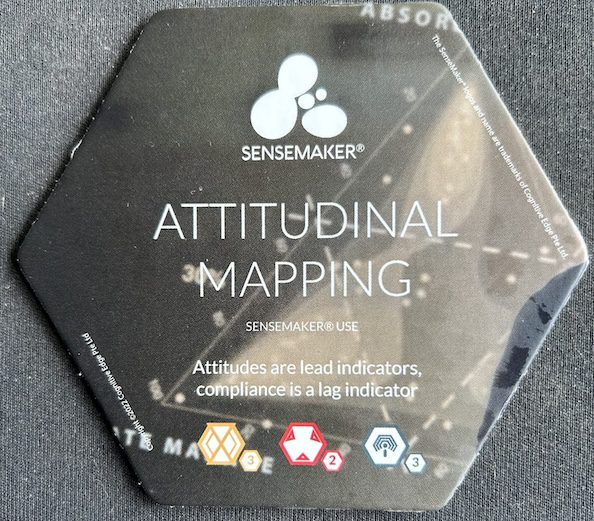
This hexi published by Cynefin Co has really challenged me throughout this year to think differently about noticing and enabling change.

With Dave’s permission, I often paraphrase this hexi in conversations about technological change or economic development-related work as follows: “Attitudes are lead indicators, evidence/data is a lag indicator”.

Those that know me would understand why this hexi is so profound to me.

Already, this specific hexi has shaped many of the commissions that I have taken on this year. It also helped me to turn down several projects.

  • For instance, it became the refrain in designing a Sensemaker Engagement for an international development project to track emerging signals of change over 12 Eastern European and Western Balkan countries.
  • This hexi-card also inspired our Mesopartner 20th anniversary Sensemaker project, where we scanned how economic development practitioners have engaged with and used our Mesopartner instruments over 20 years and how they observed changes unfolding in the development field.

One of the projects that I am leading is the Technological Change and Innovation System Observatory project hosted by TIPS in South Africa. The challenge we face in this project is captured by this same Hexi. Many companies are experimenting with or building their competencies in frontier technologies. The challenge is that these shifts of focus and investment do not yet show up in any reliable datasets (in fact, official data suggests that more investment in the same polices that have not been working are needed). In essence, the interest and focus of our innovators are shifting to capabilities that do not yet exist in domestically. Not only does this reduce the demand or throughput that is needed to make domestic technological competencies viable in the public and the private sectors. It also threatens to drive a bigger gap between those who have (new technology, new knowledge, new opportunities) and those who have not (old technology, conventional knowledge and mature markets) in an already highly unequal country. This hexi gave me the courage to shift from trying to find better data, to paying more attention to subtle changes that signals shifts in behaviour. It demands that we interact with the people that are using new knowledge in different ways, instead of trying to make sense of data. More about this in a later post.

A final remark about the impact of these kits and this particular hexi card on my year. These kits helped me to shift from a strong reliance on developing better diagnostic instruments (what is wrong, or what already happened, as captured by data and evidence) towards an emphasis on what is possible from where we are now, which tensions or contextual nuances can be explored for opportunities to innovate, or how innovations or new capabilities that have gone unnoticed can be amplified (or dampened). Already in this year I have been able to assist my clients to not diagnose that past, but to embrace the possibilities of change offered by the contexts they are immersed in.

***

The hexi-kits published by Cynefin co have really inspired my thinking. Cynefin co has taken collaborative approach and I am delighted to be part of the community of practitioners that are developing additional method packs.

Cynefin co are currently working on version 2 of their kits and I can hardly wait to see what they contain. For the last year I have been working in different collaborations to refine or create new hexi add on packs:

  • In July, we released a prototype of our Systemic Insight search and discovery hexi kit to participants of our Summer Academy held annually in Berlin. The featured image of this post is where we showed the participants how to use the Systemic Insight hexi kit.
  • We also released our Systemic Competitiveness cube prototype as part of our complex facilitation kit.

We are currently working on several additional kits that are all in different stages of development. Currently, I am working on:

  • A hexi add-on pack focused on the diagnosis and improvement of systems of innovation and learning. This kit draws on innovation system, evolutionary economics and new institutional economics to equip stakeholders to identify opportunities to strengthen the learning and innovation practices in an industry, region or around a set of knowledge domains.
  • A hexi add-on pack focused on local economic development (with Christian Schoen) drawing on our Mesopartner experience that will equip local collaborators to assess and identify improvement and innovation opportunities in a local economy.
  • A hexi add-on pack to diagnose and improve entrepreneurial innovation ecosystems that will equip innovators and network weavers in the private and the public sector to strengthen the interdependence and connections using an ecosystems approach.

I am also collaborating with others in the Cynefin Co network to develop hexi-packs on knowledge management, trust building and technological change.

Some of these ideas are still in their infancy, while others are already quite far advanced. I will only release the next kit after Cynefin release the next versions of their hexikits in the coming months.

In closing, have you been experimenting with these same methods? Are you getting different results as well, or do you also sense that you should shift from figuring out what happened to what is possible?

Let me know how it is going, perhaps we can exchange ideas going forward.

Disclaimer. I am not an employee of Cynefin co. However, I am a paying member of the Cynefin Co premium membership network. I wrote this post because I believe it is important to celebrate and acknowledge the profound effect that Dave’s ideas and methods have had on my praxis.

2023: The themes that I circled (Post 1).

I want to share the themes I have circled during the last year. Maybe I did more reflection than usual, as we have celebrated Mesopartner’s 20th anniversary this year.

Co-evolution is the first theme I have circled back to many times over the year. In the first half of the year, I tried to work through some of these ideas in different blog posts. The importance of understanding that in a co-evolution, changes in one element enable or demand changes in another. When we say that institutions, technologies, companies and places co-evolve, it implies that a new possibility or competence (or a constraint) in one dimension will shape what changes are possible in other areas. Or the interdependencies might resist lasting change.

Yet, in economic development, there is often a tendency to want to fix through a theme focused mainly on one dimension (think of projects targeting skills development, digitalisation, green or inclusion) without paying attention to the interdependence that makes systems return to some form of stability. This is the reason I keep on circling back to co-evolution.

In our approach in Mesopartner, we pay careful attention to how firms, their supporting institutions, places and technologies co-evolve. It is hard to achieve lasting positive change without considering how these different spheres affect each other. At the same time, co-evolution happens in a context with many different histories, and changes are also affected by the inherent interest of various stakeholders to respond to implicit or maybe explicit pressure in their context.

In July, at our Annual Summer Academy event held in Berlin, we illustrated co-evolution in an economy by presenting the Systemic Competitiveness framework in the shape of a cube, with the volume of the cube representing the interdependence between six sides.

The Systemic Competitiveness framework presented as an evolutionary system in the shape of a cube

I must admit that this explanation worked better than I ever expected (I have been playing with this idea already for a while). When presenting Systemic Competitiveness in our usual way (think of the rainbow map of Systemic Competitiveness), the co-evolutionary interdependencies are not so visible (see the images at the bottom of this post). Firms are in the bottom layer, specific supporting institutions in another layer, with generic macro policies on the third layer and the meta factors on top like icing on a cake. Further, illustrating these forces on the Systemic Competitiveness framework diagram with lines and arrows makes the approach look like a messy closed system diagram.

However, when we show people this cube, they can immediately look at one side to describe a situation, and then, as they turn it, they can look at the same situation from another dimension or angle. We then have to remind people that the space in the cube represents the dynamics or the co-evolution between the different sides.

There was another motivation for developing this cube as a physical object, which is about complex facilitation. Complex facilitation methods are about removing the bias, question framing or group steering of a group of people as they navigate or explore a given issue. As often is the case, Dave Snowden deeply impacted my facilitation praxis with his methods of complex facilitation. The launch of the brilliant Cynefin Hexi kits last year made a deep impression on me. As a side note, we have developed an add-on Hexi-pack pack for our clients, but I will write about that later.

Let me explain how the Sysco cube enables complex facilitation.

When using the Systemic Competitiveness Framework (in our conventional map approach) during fieldwork or workshops, we must facilitate conversations between stakeholders about where certain actors, organisations, functions or persistent patterns are on the Systemic Competitiveness map. People are often more focused on correctly classifying issues rather than exploring how different things may be connected or affecting/reinforcing each other. With the physical cube, people can now use the six sides and the space within it to explain persistent patterns they observe from different angles. They can then offer hypotheses of how the issues are related from the different perspectives described on the sides of the cube, or what they think can be tried to shape the observed patterns. The facilitator is no longer required to interpret and classify the issues raised during the discussion; their role is to urge people to add, disagree, challenge, connect and document what is being discussed. I have found that in most meetings, people immediately understand the interconnectivity between the cube’s six sides. The conversation is no longer about where an issue should be categorised but how it relates to other factors.

I must add that now that I have thought through co-evolution in the Systemic Competitiveness framework with the cube, I have even invoked this image during meetings where I did not have the cube physically with me. Even without the cube present, people have understood the implications of what I explained.

To frame the significance of this method in another way. I have shifted Systemic Competitiveness from a taxonomy system to a typology, where we can look at the same socio-economic system from different yet related dimensions. Where the interconnections and dynamics were often an afterthought of the mapping process, it is now literally central to the conversation.

Below are the images showing the layers of Systemic Competitiveness we have been using in the past.

How institutions, technologies and companies co-evolve

This is the fourth post in this series about economic evolution. In this post, I will look at the co-evolution between companies and the broader institutional environment they form part of.

Towards the end of the 2nd blog, I mentioned that the design spaces within firms (and organisations) interact with different design spaces beyond their boundaries. The available “technology” modules within any organisation, private or public, interact with and are shaped by technology the modules available in the institutional landscape. The technology in the preceding sentence should be understood as “knowing how to do or achieve something specific consistently”. For example, think of the trust system needed for two companies to transact with each other. Perhaps they rely on the social institution of social relations. This worked for most economies for a long time. But with increasingly sophisticated products and services and also the more impersonal nature of many transactions, contracts and their enforcement through a legal system is increasingly important. To further make impersonal transactions smoother, standards, performance criteria and branding are all social institutions that have evolved to enable transactions.

These institutions, including the norms and the organisations that provide related goods and services, evolve with the economic transactions they enable. In some cases, the institutions lead the evolution by providing the economy with new knowledge modules or services. In other cases, unmet demand might lead to an institutional response. Yet in another case, policymakers might design policies to shape the institutional offerings or the demand patterns.

The broader institutions and economic activity co-evolve.

I want to take this further by focusing on the meso space and how this space co-evolves with industries, locations or communities.

The meso space is a design space where interventions are designed to address the persistent patterns in the economy. Most microeconomic transactions occur via markets, hierarchies or networks, and each of these forms of allocation have strengths and weaknesses. All three can fail. When a particular kind of failure persists, this can be called a market failure, management failure (for hierarchies), government failure (in the case of public services failing), coordination failures or systemic failures. The meso space is where stakeholders intentionally intervene to address or respond to persistent failures.

Because it is sometimes not helpful to use labels like market or government or systemic failures, we often describe these patterns as “patterns of underperformance”. These are the patterns we often see when we look closely at an industry, value chain, location or national economy.

Some meso interventions may be targeted at a particular industry, a technology, a region or a specific pattern. In contrast, others may target whole policy areas like industrial, technology, trade or locational policies. While most meso interventions are supposedly intended to deal with negative or problematic patterns, there is no reason that meso interventions can also be designed to leverage positive characteristics. That is exactly what many tourism or investment promotion strategies aim to do.

Meso interventions might be a policy, project, programme, service, or organisation. Sometimes an existing organisation might launch a new service or provide additional functions to address a particular pattern of underperformance in the economy. This, in turn, might result from a particular ministry deciding to create a policy to address a particular issue, like deciding to invest in an incubator to develop particular solutions the company might be interested in. I know this might sound unclear, but when a policy or strategy is specific in its focus, we describe it as a meso instrument. In contrast, macro policies and strategies are more generic and are not specific to an industry, technology or location.

The public sector is a dominant actor in the meso space. However, in most countries, the public sector does not act like one stakeholder. There are different government departments and publicly funded agencies, at different levels, all with different jurisdictions or mandates. Just like coordination failures can occur in the private sector, coordination failures within different public functions can paralyse a country, industry or location.

However, not all meso policies and interventions are about the public sector trying to be the benevolent private sector supporter. Companies can also design policies that shape the economy around them. For instance, a large manufacturer might have policies to develop their supplier networks, to make the location where they are based more attractive, or to support particular public interests. Not-for-profit or non-governmental organisations can also have development policies to address particular economic patterns. So meso policies and programmes can be designed or implemented by the public, private or civil sectors.

While some economic development practitioners are often biased in favour of addressing market failures, the meso space must often also address government and other systemic issues. For instance, the meso space is often critical to designing or implementing programmes to reduce inequality, provide more effective public goods, reduce coordination problems, maintain and expand critical physical and digital infrastructure and address other social priorities.

Suppose a persistent pattern of decline plays out in a location or an industry over time. For instance, let us imagine that the city centre and its key economic activities are in decline. It is unlikely that this pattern of decline can be addressed by only the public sector implementing a few projects. Most likely, the pattern can only be arrested by mobilising many different public, private and civil organisations and then pursuing projects together for extended periods. Interventions aimed only at the private sector are unlikely to work by themselves, as renewal and investment in public organisations, civil and social infrastructure would mostly likely also be required. The location will change as the economic activities of enterprises and the supporting institutions co-evolve. In most cases, this is a process that takes time.

This example illustrates how industries and institutions co-evolve. As the city centre declines, social institutions and networks might also decline. At the same time, new informal economic activities might arise in the place, but this might lead to an acceleration in the decline of formal economic activities. Renewal in public, private and civil organisations might be needed to reverse this trend. At the same time, investments in public infrastructure and attracting private investment are needed. These kinds of initiatives will shape the incentive landscape for investors, individuals and entrepreneurs, just as the kinds of investors, individuals and entrepreneurs might play a role in deciding where to start or what to do.

It is impossible to fix persistent patterns of underperformance in the private sector through the private sector alone. This is at the heart of systemic change: the recognition that firms and their meso landscape of interventions, programmes and organisations co-evolve. Sometimes we start with the firms and then try to invigorate the meso landscape. At other times, we may start with the meso landscape and try to make it more resilient, innovative or valuable to the private sector, the community or the location. But we also have to think both of the micro level where transactions take place via markets, networks and hierarchies, as well as the meso landscape where incentives, investments and coordination takes place. Any systemic intervention would typically involve coordinating the development efforts of the public, private and civil sectors over extended periods.

The challenge is that co-evolutions are not designed ex-ante, although it is possible to catalyse changes in the public and the private sector if there is enough willpower and incentives for change. Every small change creates further opportunities for change by making knowledge or technology modules available. Any idea or modules that become available in the economy, even if it was meant for a specific purpose, becomes part of the substrate of ideas that others can use in new combinations to innovate or transact. This may lead to a further changes in public policies, or to further changes in the institutional landscape, which in turn may lead to additional services or technologies becoming available to the economy.

This is how industries, institutions (both norms and organisations), technologies and locations co-evolve. They contribute knowledge modules or functions to the economy, that others can combine with to create value. And so it goes on.

If you think of the context where you are working, can you see examples where changes in the private sector (performance) lead to changes in the meso landscape or the other way around? Where did new or adapted services from the public meso programmes shape a location, industry or technology? Can you think of any unintended consequences or benefits, in other words, that was not designed intentionally but happened because of preceding changes?

Alternatively, where did changes in the private sector result in adaptation or changes in the public sector?

Lastly, can you think of examples where a civil or not-for-profit organisation’s behaviour (or interventions) resulted in public and private sector changes? How did the system co-evolve as a result?

You are welcome to share your thoughts in the comments below. Or just continue sending your comments to me by email or social media. I value your comments and suggestions.

Image credit: Image created by DALLE on 22 February 2023. The prompt was to create a drawing showing the relationship between urban planning and universities.

The modules that evolve

This is the third post in this series about economic evolution. In this post, I want to focus more on the modules that the evolutionary algorithm act upon that I mentioned in the previous post.

Ideas are the most fluffy evolutionary material that spreads between people and organisations. These ideas spread via formal means (like education, formal communications, management decisions or regulations) but also via less formal means like the media, stories, people moving between places and social networks. We pick up ideas as we move around in society, and often we combine these ideas with our own to create completely new idea combinations. I always ask people I interview where they got their ideas for innovations from, and I have heard the most amazing stories of how they took an idea developed in a completely different context and made it work in their own situation.

Tracking how ideas spread in society is tricky, partially because we cannot always remember where we heard or saw something that triggered a thought.

In the first post, I explained that Nelson and Winter (1982:14) preferred to use “routines” instead of “ideas” in their theory as the material that the evolutionary algorithm act upon. Routines are relatively stable ways of arranging physical and social technologies to perform certain functions. Even if they can come about in an arbitrary form, organisations tend to replicate routines internally, and other organisations also copy and adapt routines that appear to work well.

Eric Beinhocker (see the 2nd post) argues for using “modules” as the primary material on which the evolutionary algorithm acts. He agrees with the co-evolution between physical and social technologies but adds that there is a third design space, namely business plans.

“A module is a component of a business plan that has provided in the past, or could provide in the future, a basis for differential selection between business in a competitive environment.” A module is made up of configurations of routines from the physical, social and business plan design spaces.

Beinhocker, 2007:283

Continuous decisions about the composition of these modules must be made in any organisation or company. These routines and modules can be pretty unstructured, but the theory holds that the better-performing modules will be replicated within and beyond the organisation. In contrast, the less-efficient modules or routines will become obsolete when replicated less. However, even inefficient or unproductive modules can persist due to stubbornness, sunk costs, pride or ignorance.

A challenge we face is that the many internal marketplaces (within organisations) where different concepts or module formulations are pitched against each other do not work effectively. In addition, companies relying on inefficient module configurations can still thrive in uncompetitive marketplaces because the markets cannot select better-performing alternatives.

Over the years, I responded to this issue through the instigating innovation series and my teaching at various business schools.

Those organisations that constantly develop or search for new modules or tinker with their existing modules because of anticipated changes in the broader environment can be described as having dynamic capabilities. Dynamic capabilities cannot be bought, it is built through the intentional behaviour of entrepreneurs, managers and employees. David Teece is one of my favourite scholars studying dynamic capabilities, and here is his definition:

Dynamic Capabilities are the firm’s ability to integrate, build, and reconfigure internal and external resources/competences to address and shape rapidly changing business environments. 

Teece et al., 1997, 1990

Teece must often repeat building dynamic capabilities is about achieving abnormal results over the long term. The capabilities part is about the investments in abilities, skills, routines and relationships that are enduring AND that are distinct from what competitors may be doing. The dynamic part refers to the ability to adapt and proactively create market conditions that favour the company. It is about an internal culture of change, experimentation and recognising what works (and what does not work). Why I took this detour is that we need to find ways to foster dynamic capabilities in developing countries in both the public and the private sectors. We have too few organisations actively trying to create new modules that are then adapted based on how they perform in the marketplace.

Back to the main thread. Investments in modules create path dependency, especially when all the investments are along a certain trajectory. In the software and services sectors, companies can change direction faster than in the manufacturing or public sectors. This is mainly due to the way fixed capital is invested in plant, equipment and infrastructure. Once committed to a specific configuration of modules, it may cost a lot of money to change direction.

Whereas routines can often be observed and replicated between companies or contexts, modules are often harder to observe and copy. For example, we can visit a factory and see some physical and social technologies arranged in routines. We can observe how raw material, processes, people and workflows are organised on the factory floor. However, the modular knowledge units combining physical, social and business plans are harder to observe or measure. The hidden parts include the internal incentive structure to innovate and resolve problems, the past learning about what did not work and should never be attempted again, etc., how the factory is connected to suppliers, clients and headquarters, and so on. Some parts of the modules are harder to observe because they weave together past decisions, strategies, funding mechanisms, and future expectations using combinations of physical and social technologies. The machine standing there or how people work together is just the visible tip of the module (or configuration of modules).

The irony is that even management may not realise how much tacit knowledge is involved in the logic that weaves the many different modules combined in a single unit of an enterprise in the modern economy.

From an innovation perspective, there is something else to note about how these modules are created, adapted and disseminated in economic system. The ability to identify, absorb, create and deploy these modules is cumulative. Think of lego bricks. The more modules a specific company has access to or has tried before, the more variations it can create, and the more creative solutions it can select to try in the marketplace.

When this happens over many companies in the economy, markets and users can select from more variety, and better ideas are replicated and amplified in the economy. We know from the research by Cesar Hidalgo, Ricardo Hausmann and the Centre for International Development at Harvard, that these winning knowledge modules can be mapped in the Productspace. (I have a hidden section on my blog site where I have documented some of my experiments and visualisations with this approach – you can access it here).

The experience of selecting combinations or transferring modules to other business areas is cumulative. Companies building modules drawing on different or technological knowledge are better positioned to create entirely new innovative architectures because they can draw on modules from divergent knowledge domains. In contrast, companies that can only manage knowledge modules drawing on narrow knowledge domains are more likely to become specialists. The narrower the range of modules, the higher the risk of being disrupted by other competitors that can build modules on a wider front.

It is not only companies and public organisations that build up these modules. Industries can build modules. Universities play a key role in introducing recent or reliable modules into society. Some modules are described in sufficient detail that can spread via blueprints, technical documentation or software code. Members of online communities can together develop knowledge modules in a distributed way. Just think of the power of Linux or other forms of open-source software that is developed in a distributed way.

Modules can also be accumulated in a society, like the knowledge of how to organise a certain kind of festival, or the modules accumulated through dealing with certain phenomena from the environment. When people change jobs or move from a workplace, they carry with them some understanding of the modules and their sub-routines with them. However, turning some of these modules into a business unit, product or process might require investment in developing the missing business plan areas.

In some locations, office parks or regions, knowledge about certain modules may be developed or may flow more easily over organisational boundaries. Of course, this process may be fostered by developing unique public (or private) infrastructure and through social networks.

I’ll go ahead and conclude. Entrepreneurs, managers, investors and public officials have to intentionally decide where to build modules in their organisations. These modules will typically combine elements from physical and social technology design spaces with business plans. Modules will evolve as they are selected by the organisation (management) and by the market. These modules are cumulative, those that have access to more can also create more variations. Those who draw their modules together from more divergent knowledge domains may have a long-term advantage over those who specialise in building capabilities in a narrower field. Dynamic capabilities are about intentionally investing in capabilities, and continuously evaluating, adjusting and refining existing modules with new ideas from beyond the organisation. Not all the modules originate in a firm, some are present in a community, or a network or are drawn from other companies or contexts. This is easier in some places than in others.

Some questions to explore in your own context:

  • In the industries or domains that you work in, what are the modules that you can identify?
  • How are they changing?
  • Who are the pioneers that are accumulating modules from divergent knowledge domains?
  • How do they compare to those mainly focused on developing modules in a narrower field?
  • Which public and private organisations have built up dynamic capabilities? In other words, they are constantly reflecting on their performance, and constantly working on building capabilities based on their understanding of their own situation in relation to changes in the broader context. How are these organisations managed, and how does their performance compare to more conventional organisations?
  • How are the accumulation and adaptation of modules fostered or promoted in certain areas, knowledge domains or industries?

Please share your thoughts in the comments, or drop me an email.

Image credit

The image at the top of this blog post was created by DALL-E of OpenAI. asked DALLE to create a picture of a topographical landscape with valleys and peaks.

PS.

Here in South Africa, we are all developing modules of how to cope with electricity blackouts (Our government calls it “load-shedding”, which is an excellent way of describing institutionalised incompetence).

Sources:

Beinhocker, E.D. 2007.  The origin of wealth. Evolution, complexity, and radical remaking of economics`. London: Random House.

Teece, D.J., Pisano, G. and Shuen, A. 1997.  Dynamic capabilities and strategic management. Strategic Management Journal,  pp. 509-533.

Teece, D.J. 2019.  A capability theory of the firm: An economics and (strategic) management perspective. New Zealand Economic Papers, 53.

Further reading:

If you have access to journal databases, you should also look up the fantastic work of Giovani Dosi, and also Richard R Nelson and B.A Lundvall.

Updated on 5 March 2023 with minor corrections

How technologies evolve

In my previous post, I introduced the general evolutionary algorithm of variety creation, selection and amplification.

I intentionally remained vague about what the evolutionary algorithm act upon by referring to “ideas”. In this post I will be more specific about what kind of ideas evolution acts on.

Nelson and Winter (1982) argued that the material that evolution acts upon are formal and informal routines:

“ We use this term to include characteristics of firms that range from well-specified technical routines for producing things, through procedures for hiring and firing, ordering new inventory, or stepping up production of items in high demand, to policies regarding investment, research and development, advertising, business strategy about product diversification and overseas investment. In our evolutionary theory, these routines play the role that genes play in biological evolutionary theory

(Nelson and Winter, 1982:14)

These routines could emerge through serendipity or they could be the result of the creative efforts of individuals or teams. They could originate in isolation, but very often they are combinations of old and new, or combinations of internal and external ideas tried in a local context. These routines could be arranged around particular equipment or processes, or they could be norms about how people in a workplace treat each other.

These routines become part of the technology available to the firm. Good ideas that seem to work better than alternative arrangements typically spread between organisations and teams through imitation, social networks or the movement of people. Sometimes ideas are spread by word of mouth, other times through text or the media, and in some cases through mimicking or copying (or reverse engineering). Sometimes a confluence of factors makes the same ideas or routines emerge in many different organisations at the same time. Think back to how we all had to figure out how to get our work done during the Covid lockdowns.

Within organisations, the ideas and the routines that are selected are chosen by how they contribute to the objectives of the organisation. For most companies, the contribution of these routines to profitability is important, but that is not the only criteria. External and internal incentives will shape what is deemed the selection and retention criteria. I have visited enough companies to know that profitability is not the only criteria. Within companies, there are marketplaces for ideas. If somebody makes an suggestion about an improvement or adjustment management and peers might select those ideas, or they may be rejected. But let me not digress.

Ultimately, all the routines and ideas that a company create, adapt and combine (through its internal idea markets) result in products, services and offerings that are either selected or rejected by external markets.

But we know that organisations cannot only achieve their objectives with routines. I again turn to Nelson and Winter (1982) who argued that there is a co-evolution between two different kinds of technological spaces:

  • Physical technologies are what we often think of as technology. It is the artefacts, equipment, infrastructure and even code that are used to perform a function or to harness natural phenomena to achieve a specific outcome. These technologies are methods and processes for transforming matter, energy and information from one state into another in pursuit of a particular outcome. A physical technology is not only an artefact, it also includes the designs, instructions and code needed to make it, maintain and use it. Physical technologies are typically modular and often interdependent on other physical technologies. For instance, my smartphone depends on other technologies to function like a mobile network and the electricity distribution system.
  • Social technologies are methods, designs and arrangements for organising people in pursuit of a goal or objective. Social technologies smooth the way for information to be exchanged, priorities to be set, or unexpected situations to be dealt with. Social technologies enable (or disable) learning and adapting to changes in the environment. Organising people into a hierarchy, creating and enforcing regulations or arranging marketplaces are all social technologies. Like physical technologies, social technologies are modular and cumulative. Each new knowledge module or routine that is created opens up new further opportunities for a variety of new creations.

This co-evolution within an organisation also co-evolves with the physical and social technology spaces beyond the organisation. For instance, the social technologies beyond the firm like the regulatory frameworks, the incentives in the economy to innovate, or the tolerance of failure or uncertainty will influence the physical and social technologies available within the firm.

In the same way, the physical technologies beyond the firm, like the infrastructure, access to scarce equipment or expertise or access to required inputs will also shape the choices of physical and social technologies available to the leadership.

The point is that the social and physical technologies harnessed in any organisation is not isolated from the social and physical technologies in the environment around the firm. Ideas cross over the permeable boundaries of the organisation.

Of course, we expect innovative leaders to create internal environments that are much more conducive than external environments around their firms. However, we know how hard it is to get this right. In many developing countries, leaders of companies (but also government departments) have to contend with a wide range of challenges that make the deployment of more recent physical and social technologies very hard – largely because of a lack of diversity and depth in the social and physical technologies beyond their organisation. I will come back to this in a moment.

In 2006, Eric Beinhocker published The Origin of Wealth: Evolution, Complexity, and the Radical Remaking of Economics. It is one of the books that have influenced my thinking the most. In his book, Beinhocker reframes the social and physical spaces introduced by Nelson and Winter as “design spaces” within which entrepreneurs and leaders have to make choices based on their resources, their capabilities, the external environment and the markets they are in.

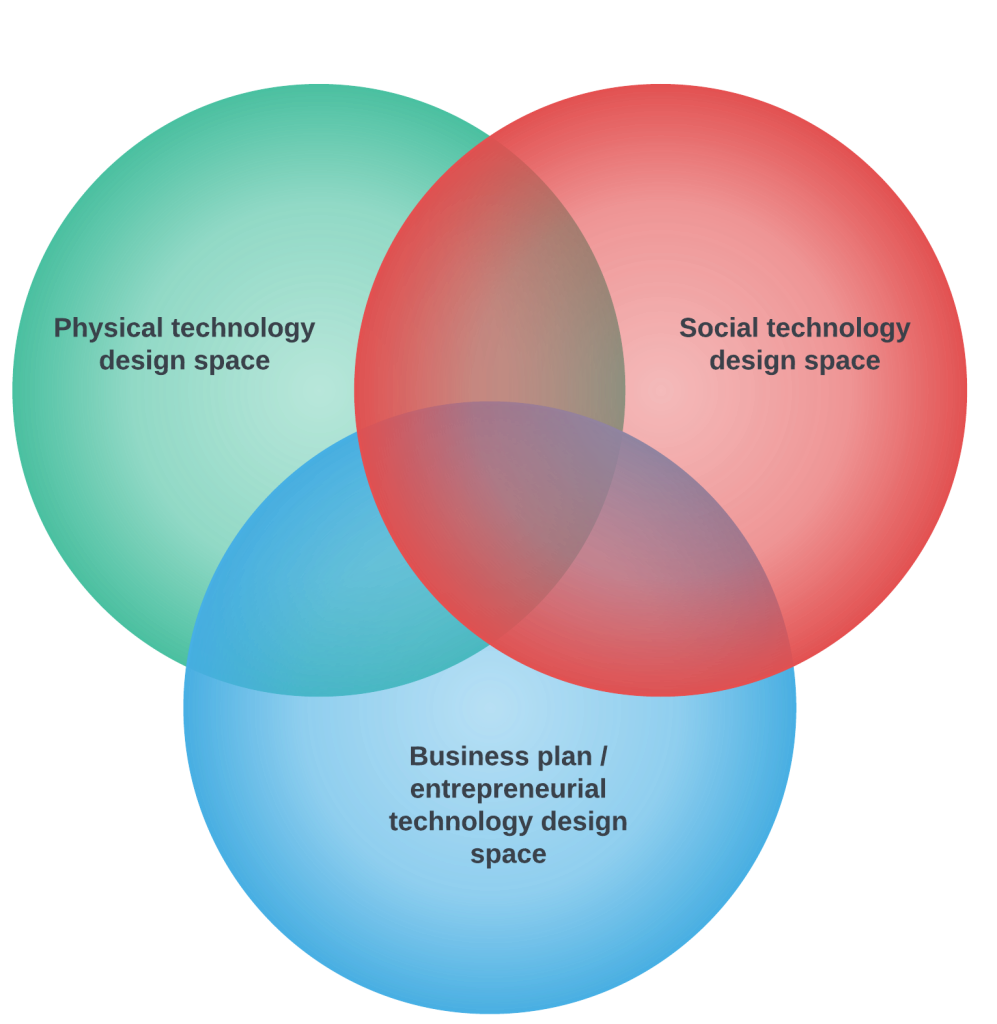
Beinhocker also introduces a third design space that he calls the Business Plan design space. This is where entrepreneurs, leaders and innovators have to meld physical and social technologies together under a strategy, and then create routines that express the resulting design into the economic world. This strategy must include ways to raise finance, attract talent, set priorities, allocate resources and create an internal environment that is typically distinct from the external environment. From my experience of working with innovative teams, I know that this business plan space could also be described as an “entrepreneurial technology” because. Just like the other two design spaces, entrepreneurial technologies are created by combining knowledge modules, insights, talent, networks and competencies into new configurations.

So now we have three design spaces that co-evolve in a given organisation. There are physical technologies, social technologies and business plans/entrepreneurial technologies. At the same time, this co-evolution in the organisation also co-evolves with the design spaces beyond the firm. The inside of the organisation exchanges genetic material with the design spaces in the immediate and even more distant design spaces.

To tie this back to the evolutionary algorithm, within each of these three design spaces, variety is created, selections are made, and “good” ideas are amplified. A “good” idea meets the requirements of the internal idea markets within organisations and eventually must also meet the fitness criteria in the marketplace.

Innovation is not only about designing better physical technologies, we also need to foster innovation in the other design spaces within and beyond firms. It is very hard (I would go as far as claiming it is impossible) to successfully innovate in one design space without affecting the innovation potential in the other design spaces.

At the same time, development practitioners must pay attention to how the design spaces within organisations affect or interact with the design spaces beyond firms. This is where the co-evolution of companies, public organisations, universities and other social organisations and the physical infrastructure co-evolve.

Sources:

Beinhocker, E.D. 2007.  The origin of wealth. Evolution, complexity, and the radical remaking of economics. London: Random House.

Nelson, R.R. and Winter, S.G. 1982.  An Evolutionary Theory of Economic Change. Cambridge, MA: Belknap Press of Harvard University Press.

Evolution in the economy

Economic evolution is often a topic in conversations with the teams I am coaching and the leaders I advise. It is a simple idea to explain, yet it allows for a much deeper exploration of why and how economies and organisations change. Even leaders without a background in economics or innovation can see the role they play in promoting innovation and economic development.

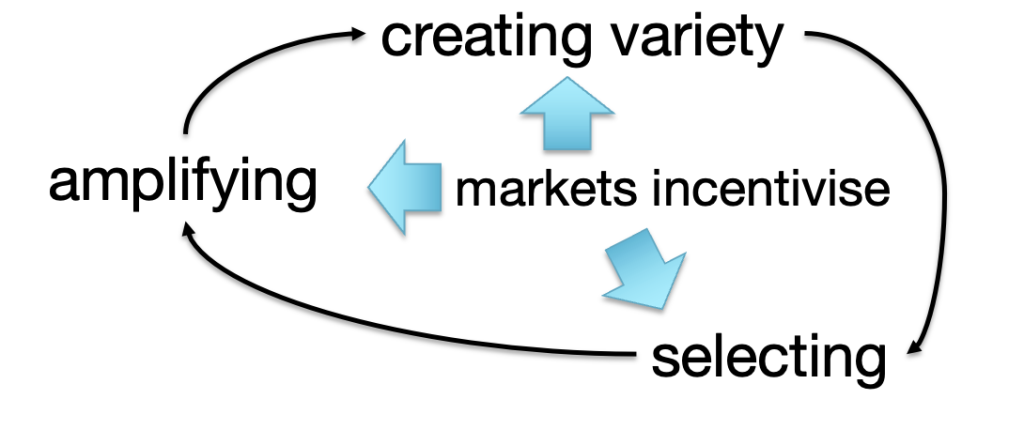
Evolution is a general-purpose and potent algorithm for finding innovative solutions to complex problems. It describes a naturally unfolding process in the economy that plays out at different levels as people, individually and collectively, search for and try new ideas or modifications of what they already know. At its core, evolution is an iterative process of creating variety and selecting designs that are fit for purpose and then amplifying these by adapting resource flows. While in nature, fitness is determined by the environment, in economies, fitness can be intentionally influenced by human actors.

The idea that economies evolve continuously is not new. The term “evolutionary economics” was coined by Thorstein Veblen (1857-1929) already in 1898. Earlier, Karl Marx and Adam Smith raised issues that are now seen as part of the evolutionary economics school. Joseph Schumpeter’s theories of economic development had a strong evolutionary perspective. Possibly the Schumpetarian idea that is best known beyond economics is his suggestion that entrepreneurs introduce innovations that creatively destroy the equilibrium created by the predominant arrangements. Much later, Richard R Nelson and Sidney G Winter’s book An Evolutionary Theory of Economic Change (1982) was a seminal work that marked a renaissance of evolutionary economics.

Below is a simple illustration of the evolutionary algorithm.

The evolutionary algorithm works as follows:

  • An innovator or a team creates some variation based on existing ideas. The new idea is often created by recombining what is already known (knowledge and technology is cumulative) with some new insights. Or perhaps they figure out the idea based on their understanding of a given situation (experience is also cumulative). It may even be that the variation is created through serendipity. The critical point is that the variety of possible solutions or stock of ideas increases, irrespective of whether there is currently demand for any of these ideas. For the variation stage to be complete, the idea must either be recognised by the innovator as worthy of further pursuit or knowledge of the variation must spread to others.
  • A few pioneering buyers, managers, investors, or other innovators then select an idea because it can address a need, or solve a problem, or plugs a gap in a given context. Selection implies that resources, attention or access to complimentary knowledge or networks are made available, leading to the concept’s further development. Choosing an idea that is different and unproven is a risk, but the people making the selection somehow recognise the idea’s potential or the limitations of existing alternatives. Innovative ideas are often further developed because they are selected. My late business partner Jorg Meyer-Stamer constantly reminded me “that technologies become efficient because they are chosen; technologies are hardly chosen because they are already efficient”. As the idea attracts more resources, funds, interest, talent and pioneering buyers, it becomes easier for others to select it as the concept is refined. At this point, other innovators may enter and create more complimentary variety, which makes selection even more likely as the ecosystem of related and complimentary solutions becomes more established.
  • At a certain point, the idea becomes amplified in the economy or the system beyond the ideas or designs of the original innovators. Where those doing the selection in the previous phase were taking a risk, in the amplification stage the risks are much lower as the innovative idea is understood better, is more credible and has more support.

This evolutionary algorithm plays out in the marketplace and is fuelled by incentives that shapes each stage. It also plays out within organisations where different ideas compete for resources.

There are ways that we can shape the incentives in all three phases of the algorithm.

  • We can figure out what incentives dampen variety creation or which incentives can be amplified to encourage learning about and exploring possible alternative arrangements.
  • We can explore how we can tilt selection incentives away from innovations that are less desirable towards more desirable solutions.
  • We can explore how good ideas that have already been selected (and thus developed) can be amplified.

I know that the incentives are often understood to be financial. But remember that recognition, being able to contribute, using one’s talent or simply solving a puzzle are also important social incentives. In the same way, fear of failure or ridicule, not having the resources needed, or not having the time or the permission to solve a problem are incentives that hamper innovation.

I want to end this post with just a provocative question. The institutions in our economies and the rules/cultures in our organisations are already shaping the algorithm. What innovations and alternatives are the algorithms in your system incentivising, selecting and amplifying? I would love to hear your reflection on this question.

If you do not want to post it in the comments, then send me an email or reach me on twitter.

Credits: The ideas in this post are inspired by many conversations with Marcus Jenal over the last ten years. In 2015, we had the privilege of deep diving into evolutionary thinking and its applications to economic development in a project funded by the BEAM Exchange. The ideas we have explored together have shaped my view of organisations, markets and how societies evolve.

Some of the challenge prospective clients that reach out to me are grappling with

Due to my research, public speaking and writing my favourite topics I regularly receive requests to help somebody that is grappling with an issue either around meso-organisational change or about technological capability, innovation or disruption.

Usually, after a few emails, we schedule a phone call to discuss their context, their intent and my service offering. Thanks to my journal and reflection processes I can track the original requests and the ensuing correspondence or projects. Over the last six months, I have noticed some patterns that are now repeating. Here are some of the most frequently discussed points. While I can help with some of these, with some I cannot help for various reasons.

Because I have always focused on training other consultants and my own clients, I thought it would be a good idea to share these early observations with you.  (Larry, Goran, Bojan, Nik, Albina, Garth, these are for you). To save you all from many emails, I have written 8 blog posts in one!

So here are the emerging patterns of 2019:

  1. I am frequently contacted by organisations or projects that believe that technological change, or preparing for the 4th industrial revolution (4IR) is a project. That there is something that we can do quickly (one of the most popular search terms on this blog site is “formula for 4IR” and “4IR method”. Preparing for technological change, responding to disruptions, or even preparing to disrupt others is a capability that is distributed over companies, public and civil organisations, regions and individuals and over time. It is not a project that ends, it is a capability that must be continuously nurtured. After addressing one threat or challenge and the next two will be on the horizon. While I love training, what these organisations really need are new technology, innovation, change and knowledge management capabilities.
  2. I am asked by development organisations to prepare their target groups or beneficiaries for the 4th industrial revolution by focusing on one threat. For instance by mastering computer-aided design, design thinking, or helping entrepreneur to cope with advances in digitalisation, 3D printing, or master some automation or sensor technologies. However, the reason why so many people lump so many technological advances together under the banner of the 4th industrial revolution is that these technologies are converging, and if they are not yet converging, they are rapidly learning from each other. That means the capabilities are converging or starting to follow similar evolutionary patterns.  That also means that very few economic activities are left untouched by changes in other sectors, technologies and markets. Again, this is not about training. It is about competence, leadership, sense-making and innovation. Perhaps it is mostly about learning, relearning and knowing what you have to master next. People also commonly confuse “digitalisation” with writing software, whilst telecommunication costs, insufficient regulatory frameworks for e-commerce, closed government (as opposed to open government) or very fast connectivity and data security are ignored.
    People that can quickly master a new domain, like machine learning, big data or concurrent design, will have a distinct advantage in the future. People that are specialised in one skill, especially a vocational skill, may be more vulnerable. But my main point here is that splitting up the technologies is not helpful. Again, the broad technical capability must be fostered. However, in addition to point 1, I want to add that the ability to track, master, integrate and leverage multiple specialised domains continuously over time is very important, even if they do not yet appear to have a relation to your industry, business or organisation.
  3. I am asked to help only the private sector in a country, region or sector. Many organisations believe that the private sector is most vulnerable to disruptions. I believe that many competent firms would be OK, but not all. Uncompetitive companies, un-innovative companies and undermanaged companies are going to be more vulnerable unless the state can afford to protect them and in so doing possibly raising the costs to the society. But what we must not lose focus of is that when one public sector organisation, programme or function fails, the effects could be far-reaching. Take for instance what happens when a local municipality in a developing country is undermanaged. It will affect the whole community. The challenge is that in developing countries the “revolution” or the “disruption” will be about social institutions (local government, universities, technical vocation colleges, schools, or whole governments etc.) that will be caught in a weak position – and unable to catch up or get ahead. So supporting the private sector in a place where many public institutions are failing is just naive. You do not address a market failure by focusing mainly on the private sector, just as you do not address government failure by only working with the government. 
  4. This point is an extension of the previous point. Many organisations that approach me want me to help them get the private sector more innovative. But here is the problem. It is not possible to develop a prosperous and successful private sector without the same happening in the public sector and in civil society. Actually, any form of innovation starts with a good basic and often some good higher qualifications. The changes that people can work together in a sophisticated way, without these arrangements being replicated in other sectors are naive. Complex forms of cooperation within an organisation, company, NGO, school or church depends on the ability to work together to solve problems that span over the ability of individuals. This needs trust, and it comes from the broader society and its formal and informal institutions. You cannot develop the private sector in a vacuum. Management teams of companies are not suddenly going to behave in novel arrangements that don’t exist in schools, sports teams, civil organisations, universities or political parties. Maybe it is possible to develop only the private sector in the short term, but for long term economic development, healthy public sector organisations are a pre-condition. The social technologies that enable the private sector to innovate, to combine old and new ideas, to figure out new ways of arranging teams around objectives, problems and opportunities are in most countries developed with the direct or indirect help of the public sector. Often these ideas are first developed around social, political or local problems. The quickest way to instigate innovation is to focus on creativity, better decision-making and increased performance in publicly funded programmes and civil organisations. Do you want to quickly get new forms of dialogue or new technology to spread in a location? Start with the schools, the local theatre, church or community organisation – and watch how fast the private (and hopefully public) sectors will catch on. Often the most adaptive private sector leaders are serving on the boards of the schools, local NGOs, and they take up new ideas very quickly.
  5. I am often asked to assist struggling industries in developing countries to become innovative, competitive or successful. Maybe the companies were successful once, hopefully not too long ago. The challenge with sectoral upgrading is that the prominent companies must either be very competent in market development, or they must have mastery in a technological domain that has a long cycle time still ahead. With one of these two domains mastered product and process innovation is possible, but perhaps not easy. The real challenge is often that in developing countries the business model innovations are the hardest and the cost of failure are also very high. Thus the incentives to try new business arrangements are low. If the companies are not able or willing to rethink or change their business models, then there is very little one can do. The entrepreneurs that will be successful in five years from now have already made decisions to master emerging markets and technologies today, and they have found a way to foster their competence in these domains within their current companies. They have innovated in the business arrangements, enabling them to innovate in products and processes. If there are no companies that are able to do this it is most likely the best idea to rather invest public funds into investment promotion, education, tech transfer and incubation to try and offset the job-losses when the current companies fail.
  6. I am often approached by internationally funded development projects to do something to create employment in a sector or a region in a developing country. The challenge is the sectors, supporting institutions and even the approach (the ideology) is already decided and cannot be changed. Often even a quick analysis and a few phone calls reveal that the development project has read the situation wrong, or they ignored strong messages of resistance because they believe in their ideology. Yet they persist, and now they are not getting the response from the stakeholders. I notice many of TVET and green economy projects that fall in this category. Even if there is great value in what these organisations have to offer, if they are not responding the binding constraints or challenges (the decision points) faced by the entrepreneurs and government officials, their offer will not be taken up. Or it may be taken up but it won’t stick. My approach for the last few years has been to wait for the projects to realise that they will never reach their targets and then to propose that we try some alternatives to see if we can get some impact. Or I simply turn down the request. Development programmes in the education sector are often so stubbornly focused on their own ideas that work in their own context that they are not willing to consider developing country needs.
  7. I am often asked to help manufacturers or development organisations in developing countries to prepare for technological disruption at the technological frontier. That means technologies that are newly emerging. The problem is, most companies in developing countries will not be disrupted by cutting edge technology. They will be disrupted when older technologies reach new levels of efficiency and scale, perhaps in combination with newer technology. That means that an older technology evolves to become available as a utility service or on a pay-per-use basis. That is how the fundamental disruptions occur that completely displaces existing markets and sociotechnical arrangements. An example if PV electricity to homes. In many developing countries a homeowner can now buy panels, inverters, brackets and batteries from hardware retailers (or online). It may be illegal in many countries, but homeowners can take their homes off the grid. If enough homeowners do that, national power utilities may collapse. Perhaps another example is that as developing countries switch to fibre internet connectivity, all the IT companies that used to provide small servers, desktop maintenance, server maintenance, cabling installations, etc are disappearing. They are disappearing because they have not long ago mastered an older technology (shared server-based computing, remote network maintenance) that has recently become a utility-based service.
  8. I am asked by an international development organisation to help with a project aiming to support 25, or 50 women, girls, lecturers, youth or a handful of companies. 25 out of a population of thousands or millions is really depressing. This is not systemic, nor is it sustainable. I cannot get involved in these projects, my conscience will not allow me. If any beneficiary group is so marginalised or excluded that 10, 20, or 50 seems like a good indicator of impact, then we should really be going back to the drawing board about the complexity of the system and our sensitivity to the decision points, the attractors and the boundaries in the system. Most likely we should be targeting changes in mandates, roles and functions of institutions and not be focused on individual beneficiaries. The system must be very dysfunctional (meaning somebody must be benefitting enough to keep it in this state), and focusing on getting a handful of people through the system despite all the resistance or challenges is not systemic. In fact, everybody that is inspired by this handful might suffer severe challenges to follow in their footsteps. In a complex system, fixing a little part and then scaling it up does not change the fundamental working of the system. But let me stop venting now, I am asked frequently enough to talk about the potential of complexity thinking applied to developed. Maybe this deserves a blog post of its own.

These are just some thoughts about the challenges that some organisations are grappling with when they reach out to me. These are some of the common objections that many clients are challenged by based on my writing, teaching or speaking. Perhaps these are also the reasons why some clients decide to appoint somebody else or to never reach out to me in the first place. But these are also the points that keep me awake at night, the recurring themes that come up even when I am trying to walk the dog.

Let me know if any you’ve also had these conversations, or whether your organisation, funder or clients are stuck on the same issues. If there is sufficient interest in any of these points then we can perhaps think of how to explore these deeper, or perhaps we can even get together to brainstorm these.

The evolution of technologies, industries and regions

In the earlier research on technological evolution in the 1970-1995 period, attention was mainly paid to either a whole economy or a single sector or technological paradigm. It is broadly understood from this research that different industries and technologies evolve at different rates. This means that over time, some industries may be more important than others, or at least, some may be accelerating while others may be stagnant or declining. In recent research by Saviotti and Pyka (2013), the emergence of new technologies and industries (and the goods and services that they provide) is seen as offsetting the diminishing returns that are innate in the development of existing technologies. Nelson (2015) argues that this is a reason why absorption and further development of these technologies are necessary to maintain economic development.

In enabling technological evolution in countries, a whole range of actors play a part. Individuals and informal networks, to large and small firms all play a role. However, for the last century, most technological advancements have been supported by scientists, the academia and professional societies and a range of supporting meso organisations. In Europe, professional associations often play an important role in the deepening and dissemination of technological knowledge.

I want to come back to the meso organisations mentioned in the earlier paragraph. Meso organisations or functions are created in response to structural issues like market failures, sometimes government failures or persistent patterns of underperformance in the economy. These meso functions are critical in supporting economic actors to discover what is possible in a given economic context, to assist stakeholders to overcome coordination failures, and to provide critical public goods (such as scarce or expensive technological infrastructure, demonstration facilities, testing facilities, public research, and so on).

The meso functions enable a society, industry or even the public sector to discover and absorb new ideas, they enable learning by doing, they encourage the adaptation and dissemination of new knowledge or technologies, and they connect different stakeholders to overcome coordination and search failures. These meso functions are a critical ingredient in the local innovation system as they extend the technological capability of a given sector, industry, market or region in a country.

You would have noticed that I have not yet mentioned universities and public research efforts. This is simply because I have written about them so often as they form a critical part of the local innovation system. I sometimes even think that the higher education sector receives too much attention. Yet, education from basic schooling to higher education plays a critical role. For me, a university is an important meso organisation, and research centres, technology extension centres and laboratories that provides testing facilities are all important meso functions or maybe even meso organisations hosted by a larger organisation.

The importance of the higher education sector in the technological infrastructure varies for different parts of the economy. Nelson contends that scientific and technological research and teaching, especially the more applied fields, provide a base of knowledge that is accessible to all technically sophisticated individuals and firms working to advance technology in a field (Nelson, 2015). However, different fields also depend, to different extents, on scientific and formal research and technology support. Therefore, measuring journal articles and research outputs as a contribution to the national innovation system or as a proxy for technological capability will always paint only a partial picture. It really also depends on the pace of change and scientific advancement that is taking place in a region, a technological domain or an industry.

Furthermore, different industries depend, to different extents, on government support and incentives. In some fields public support is crucial, and in other cases, provides little incentive or value. In many cases innovations preceded science, and continued development is only possible due to the iteration between researchers and enterprises. Nelson continues that the kinds of firms that do most of the innovating differ – in some fields this tends to be large, established firms while in others it is smaller firms or new start-ups (Nelson, 2015).

Nelson draws an important conclusion that has really shaped my own thinking. Nelson states that there is no single set of policies that are applicable to all technologies and industries. What will be effective in some fields will not be in others. For instance, small business promotion in some sectors in one country could work, but it could be ineffective in another country.

In South Africa, with its very high coordination costs and high compliance costs, smaller enterprises in the manufacturing sector are at a huge disadvantage. The distance to sophisticated buyers and the challenges with exports compounds the difficulty for smaller enterprises to compete globally from the local base.

Nelson is also known for his writing on the importance of a wide range of social institutions, both formal (for example a cluster development organisation) and informal (the trust networks between members of the clusters). He refers to these social institutions as social technologies, and he argues that they co-evolve with physical technologies to enable economic development. These social institutions range from central banks to a diverse range of firms, but importantly include other forms of organisations such as scientific and technological societies, universities, government agencies and even capital markets. These institutions are the focus of the discipline of innovation systems.

Nelson emphasises that “that when a potentially new technology emerges, new institutions often are needed to develop it, and invest in and operate effectively the economic practices based on it”.

Nelson acknowledges it is not an easy task, as it is hard to predict which emerging fields of promising new technologies are going to be important in driving economic progress in the future, and which will have a modest impact. The policies to create or reform institutions need to be adaptive and flexible. Arthur (2009:186) confirms the view of Nelson and argues that “We cannot tell in advance which phenomena will be discovered and converted into the basis of new technologies. Nor can we predict which combinations will be created.”

That brings me back to my intent with this post. When we look at technological disruption and change, it is very easy to get caught up in the potential or risks of any given technology. But we must not take our eye of the informal and formal institutions, market systems, regulations and technological domain specific organisations that are needed to make a new technology viable. At the same time, we also have to figure out how to gracefully exit older technologies and how to either shut down or transform public organisations that once had a critical role in supporting those industries and technologies.

Again, I repeat, the so-called fourth industrial revolution is going to be more disruptive at the level of institutions and social arrangements than it will be disruptive for the enterprises that are competing at the technological frontier.

In South Africa, we have a triple-challenge.

1 – Our institutions change very slowly, and we have huge social tensions about how to allocate resources and wealth in the economy. Our local municipalities and local economic development activities are ineffective (with some exceptions in some of the larger metros). Yet, local authorities have hardly any influence over the quality and effectiveness of national meso programmes that are supposed to enable economic change.

2 – This is compounded by a largely uncompetitive economy with lots of market concentration.  The regulatory burden in the economy keeps a lot of potential entrepreneurs employed in the corporate and the public sectors.

3 – Our discussions in South Africa about technological change, technological capability and the promotion of the innovation system is dominated by a linear logic of science leading to technology leading to innovation (the so-called STI approach). There is not enough attention being paid to the eco-system of organisations, technology extension agencies that can help enterprises master new technological domains, reduce coordination costs, the so-called Do, Use, Integrate (DUI) kind of innovation. On that point, we also have very few (if any) technological organisations tasked with transforming or upgrading whole sectors or regions in the country from a technological perspective. Everything is aimed at one enterprise at a time.

My research agenda:

This is what my research is about at the moment. I am working with a team from TIPS and the dti (South African Department of Trade and Industry) to strengthen the visibility of this technological meso network, while also strengthening the public sectors ability to spot technological disruptions and to be more pro-active.

Please sign up below if you want to stay informed of our progress as I will not be able to share all of our learning in the public space all the time.


Sources:

Arthur, W.B. 2009.  The nature of technology : what it is and how it evolves. New York: Free Press.

Nelson, R.R. 2015.  Understanding long-run economic development as an evolutionary process. Economia Politica,Vol. 32(1) pp. 11-29.

Saviotti, P.P. and Pyka, A. 2013.  The co-evolution of innovation, demand and growth. Economics of Innovation & New Technology, Vol. 225 pp. 461-482.

Technological change cycles

This is the 3rd post that draws from the research and advisory work I am currently busy with to strengthen South Africa’s technological capability to detect and better respond to discontinuous technological change. The citation information for this post is at the bottom of this post, and a link to the research report that I have copied this from is here.

During the 1980s several scholars[1] recognised that technological change follows a cyclical pattern and several models were put forward to explain the phenomena. These models are still in use today and have been found to be active at different levels of technological change. The broad consensus was that a technological change cycle:

  1. Starts with a technological discontinuity or disruption, followed by a period of unstructured and often chaotic innovation when a new idea or concept is made possible (based on preceding developments). This disruption results in a fluid or turbulent development phase during which many ideas are developed, tried and promoted as the next best thing,
  2. That is followed by an era of ferment from which a dominant design emerges; and
  3. This is followed by an era of incremental change during which the dominant design is elaborated.

This can be illustrated with the widely recognised Abernathy and Utterback (1978) model with its three phases of change that are illustrated in Figure 2. The three phases are a fluid phase, a transitional phase, and a specific phase, and is similar to the cyclical pattern described in the bullet list above. Other scholars used slightly different labels, but the characteristics in the different phases are all more or less the same.

Abernathy and Utterback

Figure 2: The Abernathy-Utterback model of technological change

Source: Abernathy and Utterback (1978)

The rate of innovation is highest during the fluid phase, during which a great deal of experimentation with product features and operational characteristics takes place between different competitors[2]. Because of all the changes in the product composition and characteristics, process innovation typically lags. Buyers and users are often confused or overwhelmed during this phase fearing that the benefits are overstated and that the costs of adaptation are uncertain. Only the brave and the innovative engage in finding, adapting and integrating new ideas and concepts.

In the transitional phase, the rate of product innovation slows down and the rate of process innovation increases. At this point, product variety gives way to standard designs that have either proven themselves in the market, or that are shaped by regulations, standards or legal constraints. The pace of innovation of how to produce the product increases. What was done earlier by highly skilled technicians may become automated or developed to a point when low-skilled operators can take over. Or lower-skills jobs are displaced from the production process to other functions like logistics, while the skills intensity on the production line is enhanced. At this point it is easier for bystanders and followers to engage in exploration. The early adopters are already over the horizon, while many early adopters have exited, sold out or moved on.

The final phase, the specific phase, is when the rate of major innovation dwindles for both product and process innovation. In this phase, the focus is on cost, volume, and capacity. Most innovations are very small incremental steps, improvements on what is already known and accepted. Latecomers can now engage with the technology, although it might already be too late.

The description of technological change provided above follows the generic three-step process of technology evolution: a process of variety creation, selection, and then amplification or retention.

  • During the variety creation phase there are many competing designs and no dominant logic. Towards the end of this phase a few dominant designs may emerge, but there is still much competition between ideas. This is not only a technical selection process, there are important social, political and industrial adjustments taking place at the same time.
  • During the selection phase, standards emerge for positively selected ideas, with a few designs dominating. It is a relatively stable process of incremental improvements in features, performance and results. This may be interrupted occasionally by leaps in performance as some designs are substituted by better technologies, or from breakthroughs often coming from other industries or contexts. In general, designs become simpler as a learning process unfolds about how best to design, manufacture, distribute and use a particular technology around dominant designs. This period is characterised by growing interdependence as modules are developed, substituted and standardised. There is a growing exchange and increased competence within and between different communities of practitioners. Often there is industry consolidation during this phase. It is important to note the dominant designs are only visible in retrospect. They reduce variation, and in turn, uncertainty, but within the process it is hard to predict which designs will survive the next set of radical innovations. Once a design becomes an industry standard it becomes hard to dislodge.
  • This leads to an amplification phase, in which the best ideas are not necessarily used as intended, but when technological changes spill over into areas not originally intended. This is a relatively stable process that can continue for long periods, until is it suddenly interrupted by a radically different idea, resulting in the process starting all over again.

Anderson and Tushman (1990) state that, from the perspective of the sociology of technology, technological change can be modelled as evolving through long periods of incremental change punctuated by revolutionary breakthroughs[3]. The innovation activities that take place that lead to these phenomena will be discussed in Chapter 3.

Arthur (2009:163) contends that change within technological domains is a slow process. He explains technology domains do not develop like individual technologies like a jet engine: focused, concentrated and rational. It is rather more like the development of legal codes: slow, organic and cumulative. With technology domains, what comes into being is not a new device or method, but a new vocabulary for expression, similar to a new language for creating and combining new functionalities.

A current example is the “Internet of things”, where the connectivity of physical devices are spreading from the office and smartphone devices to interconnect household appliances, industrial applications and an endless list of technologies enabling data exchange, control and new functionalities . It could be argued that this is not a new technology, digital sensors have been around for a long time, our cars, smartphones and equipment have contained them for a long time. However, the language, standards, distributed nature of processing, and developments in big data visualisation have all contributed to this technology appearing to arise from obscurity into the limelight of the popular media. A similar argument could be made for artificial intelligence, drone technology and others.

Notes:

[1] The work of Tushman and Anderson (1986), Abernathy and Utterback (1978) are still frequently cited today.

[2] Kuhn (1962) noted that in the early stages of research in a given field, the most that scholars typically can do is to report the phenomena they observe, without a unifying theory or framework to help them categorise or make sense of what they see. As a result, this stage of knowledge accumulation is characterised by confusion and contradiction. Theories are put forward but reports of deviating phenomena accumulate.

[3] This is often referred to as punctuated equilibrium by political scientists.


Sources

Abernathy, W.J. and Utterback, J.M. 1978.  Patterns of Industrial Innovation. Technology Review, Vol. 80No. 7 (June/July 1978) pp. 40-47.

Anderson, P. and Tushman, M.L. 1990.  Technological Discontinuities and Dominant Designs: A Cyclical Model of Technological Change. Administrative Science Quarterly, Vol. 35No. 4 (Dec 1990) pp. 604-633.

Arthur, W.B. 2009.  The nature of technology : what it is and how it evolves. New York: Free Press.

Kuhn, T.S. 1962.  The Structure of Scientific Revolutions. Chicago & London: University of Chicago Press.

Tushman, M.L. and Anderson, P. 1986.  Technological Discontinuities and Organizational Environments. Administrative Science Quarterly, Vol. 31No. 3 pp. 439-465.


Citation for this text:

(TIPS, 2018:12-13)

TIPS. 2018. Framing the concepts that underpin discontinuous technological change, technological capability and absorptive capacity. Eds, Levin, Saul and Cunningham, Shawn.  1/4, Pretoria: Trade and Industry Policy Strategy (TIPS) and behalf of the Department of Trade and Industry, South Africa.   www.tips.org.za DOWNLOAD


Exploring individual Social Technoliges that enables Systemic Change

My exploration of complexity thinking and how it enables leaders and collectives to make better decisions is taking me back to where I started. I started in organisational development and innovation. Then I shifted into larger economic systems like innovation systems, local economies, value chains or regions. For the last four years I have been working mainly on organisational development in meso organisations involved in technology development and innovation promotion. So I have come full circle, but I sense that I am now better able to synthesize and use my experience and ideas. Now I will focus on the role of individuals in changing economic systems.

Marcus Jenal and I wrote last year about Systemic Change. In our reading the wealth of literature on economic evolution we were were deeply impressed  by the work of Eric Beinhocker. In particular, the idea that economic development demands a co-evolution of:

  • Physical technologies – are methods and processes for transforming matter, energy and information from one state into another in pursuit of a goal or goals; they enable people to create products and services that are worth trading. A physical technology is not only the physical object itself, but both the design of the thing and the instructions and techniques to make and use it. The ability to learn how to use, make and adapt the physical objects is critical.
  • Social technologies – are methods, designs and arrangements for organising people in pursuit of a goal or goals; they smooth the way for cooperation and trading products and services. For example, the ability to organise people into hierarchies, such as companies or other organisations, which can allocate resources to specialised functions and which can learn is a social technology.
  • Business plans – are developed by enterprises and other organisations that are competing for resources, acceptance and buy-in in the economy. Business plans play the critical role of melding physical and social technologies together under a strategy and then operationally expressing the resulting design in the real world. From an evolutionary perspective, the purpose of business plans is to discover what is profitable, efficient or even possible in a given economic context. You could call this an economic technology.

I realized last week that I have spent at least five years of my career immersed in each of these three co-evolutions, but with the others not completely forgotten. From a physical technology perspective, I have always been involved in promoting trans disciplinary research, promoting innovation systems and helping innovators become more effective. I have spent a number of years supporting entrepreneurship, developing supply chains and promoting value chains. From a social technology perspective I have been working on management education, business consulting, assisting with change processes and facilitating search and discovery process within and between organisations.

Now I am taking this to a next level. I will for the next few months focus intentionally on the role of individual leaders in the co-evolutionary process. The co-evolution is fractal. I started at the highest level, the level of open systems, innovation systems, local economies and industries. Then I shifted to meso organisations, development organisations and universities, where I often focused on teams and how they use their resources in a systemic way to improve the networks they form part of.

The focus on individuals will be formal this time, where in the past this was informal, almost a by-product of my process consulting and advisory work. To equip me for this role I had to refresh my organisational and coaching skills. I have also participated in an advanced coaching programme in order to facilitate this shift in focus. Lastly, to enable this process I have exited many contracts, or not renewed contracts as they came to a close. This will enable me to dive deep. I will focus my coaching praxis on leadership support, innovation support and institution building, but with the role of the starting point. This will require many new business practices, and many new clients. I will try my best to frequently reflect here on my learning.