
Changing how a problem is framed can describe who can contribute and what success would look like

The way a problem is described often reveals what kind of expertise is required to solve it. It can also indicate whose issue it is and what resources are presumed to be needed. Experts might describe problems in ways that are hard for most people to understand, creating a sense of alienation or distance from issues that could be crucial for individuals to tackle. Many important problems, like climate change, water insecurity, or human trafficking, are presented in ways that disempower ordinary citizens.

Why is it important to frame or reframe a situation?

As process facilitators, we need to intervene and help interested or affected ecosystems or interest groups frame the problem in a way that enables them to take action, contribute what they can, and exercise their individual or collective agency in the situation. Otherwise, ecosystems and interested citizens are reduced to beneficiaries or mere spectators.

Donald Schön, a prominent thinker in process consulting, characterised framing as “the way practitioners define and interpret a situation, influencing their understanding of the problem, the relevant factors, and the potential solutions.”

Framing a problem is not only about making it more likely that novel solutions are generated because more people understand the problem. The process of reframing a problem also forces people to confront a problem and how it permeates or persists in their context or surroundings. It nurtures a deeper understanding of how an everyday problem affects others in our communities, and thus reframing enables collective action, joint learning and the strengthening of trust.

How we frame a problem significantly influences who can contribute to solving it and what success might entail.

Finally, when we can reframe a problem in a more open way, everyone who engages in understanding the problem or in contributing potential solutions becomes a co-innovator. Contributing to problem-solving builds confidence and gives hope, as it restores agency and builds social ties across social spheres.

What is wrong with how problems are usually framed?

Before discussing how to reframe a problem or a situation, I want to explain why the way we describe problems can sometimes be problematic.

  • A frequent challenge in problem framing is that descriptions are often too general. While individuals can identify symptoms, they frequently miss how the underlying causes or structural factors interact in a particular context. For example, although the effects of unemployment are straightforward to recognise, the underlying causes and potential solutions vary greatly depending on the situation.
  • Problem descriptions often implicitly favour a specific action or blame a particular actor. This is common when the problem is overly simplified or when the underlying causes are assumed to be more direct or straightforward than they are.
  • It can also serve as a method to transfer responsibility to another person.

How can we reframe a problem or a situation?

Now, let’s return to how we can alter the problem’s framing.

If urgent issues stay unresolved by stakeholders or earlier efforts haven’t yielded results, it could mean the problem isn’t effectively framed within the current context. The way the problem is presented might also be unappealing, discouraging individuals from engaging or contributing to a solution. It might also sound like someone else’s issue or a problem that demands specific expertise to fix.

Sometimes, we become so accustomed to problems that we see them as simply part of the environment we move through. We avoid confronting the issue and instead find workarounds that often come at a high cost or cause great inconvenience. The reality is that those with fewer alternatives tend to expend more effort and resources on workarounds, while those with more resources could perhaps switch to substitute solutions.

When people become familiar with long-standing problems, it may seem as if they need approval to challenge the status quo, because the common framings do not invite their input or interest. This is especially likely to happen when problems become the rallying cry of politicians who promise that they will get somebody to solve these problems on behalf of citizens.

What is framing?

Framing extends beyond simply rephrasing the problem. It involves dedicating time to thoroughly understand the problem space and the underlying structures that sustain patterns, even when they cause pain and inconvenience. Furthermore, framing is seldom a solo activity; it typically requires a group with varied experiences of the problem to collaborate, developing a shared understanding of the issue, its impacts, and frameworks.

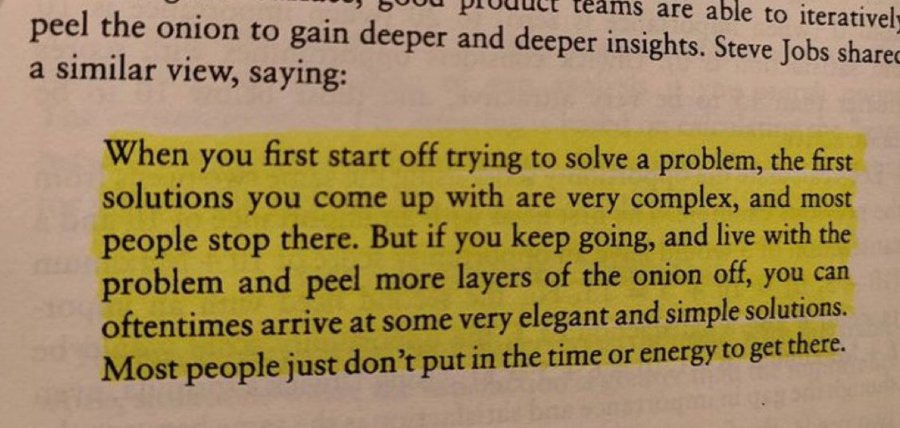
Steve Jobs quoted in Newsweek, 2006

Marvin Minsky, an early AI pioneer, emphasised that understanding involves viewing the problem from multiple perspectives, allowing different permutations or representations to be detailed as fully as possible. Essentially, this means forming a multidimensional understanding of the problem and its structure. With this deeper insight, identifying potential solutions in a particular context becomes easier. Moreover, involving more people in understanding the problem, its causes, and effects enables better contributions to solving it.

Einstein argued that “The formulation of a problem is often more essential than its solution, which may be merely a matter of mathematical or experimental skill”.

I often cite a quote attributed to Albert Einstein: “If I had an hour to solve a problem, I would spend 55 minutes thinking about the problem and five minutes thinking about solutions.”

How to reframe

Here are suggestions on how a problem, situation or opportunity can be better framed:

  • Gather a small, diverse group of stakeholders representing different perspectives or interests to help describe the problem from multiple viewpoints. Ask “how do different people experience this problem?” or “why do different people see this as an issue?” Revise the framing to include these varied perspectives and the consequences of failing to resolve the problem.
  • Describe the problem in a way that clearly shows it is a shared issue that matters in our context, and that we (as a group, not just the experts or those directly affected) collectively take responsibility for this problem within our sphere of influence.
  • If the group doubts their ability to reframe or resolve the problem, challenge them to describe the issue, why it persists, and who it impacts in at least three different ways. If they struggle to do this, it may suggest that perspectives or experiences from diverse backgrounds should be invited to join the effort. This way, the original group might also learn from the perspectives of the newly invited contributors.
  • Identify whether there are people in the system who have already framed the situation to their own advantage. When individuals benefit from a problem, they might not be eager to see it resolved. When actors benefit from a problem, you must consider their influence in undermining any solutions that could affect their interests. Is there any way we can frame the problem in a way that might also benefit those who are benefiting from the current situation, to ensure they support the solutions?
  • When describing the situation, avoid placing blame or favouring certain solutions. Instead, keep the options for solutions open so that more people feel like they can contribute in their own way.
  • If you sense that the problem is complex or messy, then formulate a description of the problem that allows for multiple safe-to-fail probes to be tried. These attempts should be carefully observed to see whether any had a positive or perhaps negative effect on the situation. These small efforts are not so much about solving the problem as about seeing whether we have any influence on the situation.
  • Treat any explanations of possible causes or solutions as “first cut” understandings or hypotheses. Encourage participants to develop “low-cost tests” to minimise the costs of testing and to reduce the risk of making things worse.
  • Lastly, agree on what success would look like. If success is hard to measure, or if the people affected by the problem cannot see the difference, then the interventions might be successfully implemented, but the problem may remain. Or worse, the original problem might be replaced by several new problems that require new solutions.

I leave the final word to Donald Schön, who argues that “Framing is not a static process but rather a dynamic one, involving continuous reframing as the situation unfolds and new information emerges.”

If you use this blog to reframe a problem in your ecosystem or network and get stuck, reach out to the weaver community or to us. Sometimes, some distance from the problem situation may make it easier to ask the naïve questions that may be needed.

This article was written with inputs from Bronwyn James from PNC and Nikolaos Archontis. It was published originally on www.mesopartner.com as a contribution to the GIZ IYBA-SEED project implementation.

Naming your initiative to signal action and to deter free riders

We have all been part of a group project in which only a few did the work, while many went along for the ride. Many change initiatives face the same challenge. A few take the risks, raise the difficult points, or frame the opportunities, while many more join in simply because they fear being done in. Or they come for the coffee.

In the early stages of a change initiative, you want to find ways to attract those willing to imagine new possibilities despite imperfect conditions. You want to reduce the risk of people thinking aloud about what can be tried and how problems might be reframed as opportunities to explore. This is hard, if not impossible, if you have group members who are cynical or who believe that some benefactor beyond the group should do something to change the conditions. 

Your first task is to create a safe space for people not only to imagine what is possible but also to harness existing resources, energies, or even lessons from the past to try something different. For now, it may be best to invite a few people personally to join your “thinking-out-loud” session. But it is not possible to keep these ideas hidden. At some point, you must go public. Firstly, trust is not built in secret. Secondly, the fact that something is being tried should inspire others. Lastly, letting others know that people are working on a new initiative might also be attractive to new investors or contributors.

But how to attract the innovators and potential contributors while avoiding the nay-sayers or those entrenched in the way things are now?

One way to do this is to ensure that the name of your initiative signals a journey towards something or an active exploration. The name must indicate that some form of additional effort, a different destination, or some risk is involved. The initiative’s name must be a first filter that attracts innovators and problem solvers, while at the same time creating a barrier for free riders and Status Quo maintainers.

Too many well-designed initiatives to innovate or challenge the status quo get stuck simply because the activity is labelled to sound like a topic that the tradition bearers, pioneers, and the indifferent identify with. A great idea may get stuck because those interested in the Status Quo or in deferring the problem to someone else outnumber those willing to explore alternatives.

People must not be included in the initiative by virtue of their current status, sector, location, profession, or any other generic category that encompasses both those who want to innovate and those who are comfortable with the present, or who have too much invested in the current arrangements. The main criteria for involvement should be your interest in collaborating and your willingness to contribute resources, information or effort.

Once you have the starting group members self-selected and you are moving in a new direction, one can always explore with the group of innovators whether somebody who did not join should be included.

In any case, as your new effort starts to show results, more people will want to jump on the bandwagon in any case.

Let me explain this in the context of some of the work we are currently supporting.

  • Ecosystems are often named by either the core technologies used (e.g. the Digital Animation Ecosystem) or a particular kind of beneficiary (e.g. the Women-in-Engineering Ecosystem). This name opens the initiative to almost everyone who identifies with the keywords it contains.
  • The promotion of adopting new technologies is often named after the technology, not for the kind of change or opportunity it unlocks.
  • The promotion of an area is often named after the location the place, not the kind of innovation or improvement that is being explored.
  • Sector development initiatives are often named after a key input, an existing process, or a key market served.

If you are going to try to get a group of people to try something new, then you should also name your initiative to signal risk-taking, exploring new configurations and opportunities to contribute to something different.

This blog post was originally published on www.mesopartner.com.

Weaving entrepreneurial innovation ecosystems in South Africa

In the second half of 2024, Annelien and I were awarded a contract to mobilise, equip and support facilitators who weave together entrepreneurial innovation ecosystems in South Africa. We were subcontracted by the EU-funded IYBA SEED programme through GIZ in SA. This project allowed us to consolidate many of the methods we developed over the last twenty years. In addition, we could improve the designs of many of our templates and supporting materials. We could also work with our long-standing colleague Nigel Gwynne-Evans, who is known for his work on entrepreneurial ecosystems, clusters, and sector development.

Our approach to promoting entrepreneurial innovation ecosystems is based on the Mesopartner Annual Reflection 2021-2022 article Fostering Dynamic Entrepreneurial Innovation Ecosystems.

Some background

The political discourse in South Africa is shifting in the right direction. There is more debate and a contest for alternative development ideas. This may sometimes feel unsettling, but the monopoly over debate has been broken. The timing is perfect for mobilising change agents, community-based organisations, local development organisations, businesses and the public sector to foster the bottom-up improvement of different entrepreneurial innovation ecosystems. 

Here are some of the important shifts in the South African economic landscape:

  • During the 2024 national elections, the most dominant political party lost its majority. It had to form a coalition with its opposition. With its majority, it also lost its dominance over the political discourse of ways to improve the economy.
  • Many of our institutions, key infrastructure, and local economies have declined and lack investment and a complete rethink.
  • There is mounting pressure on the public sector to curb wasteful expenditures and to improve public services and infrastructure. 
  • Finally, the increased oversight by opposition parties, the courts, and civil society has increased the pressure on public sector decision-makers to be more careful about implementing their programmes. 

What we have done in the last few months

Our first task in our project was to identify and engage with individuals and organisations already facilitating and promoting entrepreneurial ecosystems, even if they did not call it that. With the IYBA SEED country team, we organised three training events in Gauteng, Western Cape, and KwaZulu-Natal. Over three days, we guided the participants through various thinking frameworks that helped them assess their ecosystems and identify starting points for their homegrown (or ecosystem-grown) improvement processes. 

We challenged the weavers not to pursue an ideal ecosystem based on a normative framework that assumes everyone has the exact same needs. Instead, we argued that weavers should identify strengths and then mobilise their networks to innovate unconventionally to strengthen their ecosystems’ gaps. Our emphasis was on learning what is possible and building networks of individuals and organisations that, in pursuing their interests, also build the dynamism of the larger ecosystem. On the final day of the training, we showed the weavers how to identify potential starting points to establish coalitions for change around identified issues. 

It was not only our trainees who learned during this process. We also learned. Firstly, repeating the same event thrice in different parts of the country was extremely valuable. We could learn much quicker how to explain essential concepts and exercises. Secondly, we also learned how the three regions were different. We learned from the wisdom of several champions who have been organically weaving networks over extended periods. It was rewarding to see how our frameworks resonated with them and helped them reflect on what they were doing. We heard the most amazing stories from all over our country about how networks of entrepreneurs, public officials, local or community organisations and international funders had innovated together. 

Lastly, we spoke to and even met up with old friends, who have taken slightly different paths. And now we ended up back where we started, in local spaces where our biggest asset is the resourcefulness and interdependence of local stakeholders.

Over the next year, we will continue to support the implementation of IYBA SEED in SA and the weavers in this process. In addition, we will identify and document inspirational practices and examples of how ecosystem actors have improved not only the dynamism of their networks but also where thriving ecosystems have resulted in improved public services and infrastructure and inward investment by the private sector into areas that have been starved of innovation and funding.

Form follows function

Published, 2024/09/23, minor edits on 2025/05/08

One of the oldest explicit principles that has shaped my thinking is “form follows function”. When I joined the GTZ (predecessor to GIZ) in 2003, this was one of the first principles that my manager (Mrs Gabriele Trah) often repeated when we received proposals from our counterparts or were designing interventions in a particular context. The principle has proved very valuable ever since, especially when working in bottom-up development, as it constantly challenges us to seek an appropriate level of organisation that matches the capacities of the stakeholders with the context. At the time, it became one of the key principles of the Local Economic Development toolkit that we were developing with Mesopartner, the company I am now a partner of.

At the time, I just took this principle as a universal truth, and only recently did I discover where this principle came from. While following an interesting idea down a rabbit hole, I stumbled upon a letter Peter Drucker wrote to Bill Emmot, the editor of the Economist, in 1994. In it, Drucker corrected the editor that he did not favour smallness or bigness based on an earlier article published in the Economist. (The whole letter is worth reading, because Drucker was a really great author.)

Drucker argued that size follows function. Look at how eloquently he described the appropriate form.

“The right size is one that is appropriate to an organisations function – elephants better be big, butterflies better be small”.

Peter F Drucker, 1994

As far as I can tell, this is where the principle “form follows function” comes from. Drucker credited D’Arcy Wentworth Thompson for this idea, but Drucker seemed to get the credit for this precise formulation.

Drucker, P.F. 1994. Correspondence from Peter Drucker. In Emmot, B.Personal Communication. The Drucker Institute. From https://ccdl.claremont.edu/digital/collection/dac/id/1177/

I found this sentence valuable because promoters of innovation, entrepreneurship, or economic development more broadly are often strongly biased towards smallness and against bigness. Yet, some kinds of innovation are better suited to bigger organisations than smaller ones, or vice versa. Also, as technologies and industries change, what is more suitable for a larger or smaller organisation also changes. For instance, a large retailer can better overcome the logistics, infrastructure, and supply chain challenges in a country like South Africa. But this might change as technologies, markets and infrastructure change.

In the same letter, Drucker argues that even within a large organisation, it is necessary to figure out how to create smaller organisational units that are better able to respond to the challenges they were created for. He argued that the appropriate form is determined by the function to perform. Perhaps this is where the subsidiarity principle comes from (pushing the decision to the most appropriate and proximate level of decision making). Still, I would have to do a little more digging about this first.

I would add that Drucker’s form follows function, which seems like a universal heuristic but becomes powerful when we recognise the context. What are the functions and forms that are most appropriate in this particular context. In general, Drucker also questioned the whole form of the public versus private sector as much as he questioned assumptions about size. The business school he helped to establish and many of his publications on management kicked against the conventions of small versus big, public versus private, and state versus market.

In my work, where I support groups of people to make sense and innovate, I have to remind myself often that “form” and “function” are both equally important, and that there is a tension. Wherever you start, form, or function, you have to go to the other and then back, and then consider the context. It is not only about determining the best arrangements (form) for decision making, sensemaking or innovation, but that function, the job-to-be-done, is also important.

This is often where my clients struggle the most. They prefer the form, and the exact functions and what it would take to perform these in a particular context are unclear.

For example, in a conversation with a senior manager supporting innovation in the mineral processing sector, I was told that their organisation’s funder had specified the exact number of small businesses they had to either create or support in their activities promoting innovation in the mining sector. The form was specified before the appropriateness of the form in relation to the functions was clear. In another meeting last week, a senior public official said that we must prevent larger retailers from using e-commerce and their ability to negotiate with suppliers from destroying small retailers.

To use Drucker’s example, we often want bees to perform like elephants or vice versa.

The kinds of problems that must be solved (the functions to be performed) should frame the thinking about what forms would be appropriate, within a specific context. This is what Drucker wanted us to ponder. Furthermore, we must remember that as technologies, markets and contexts change, the appropriateness of different forms will shift. In mining innovation, the regulation and compliance costs are essential factors that shift the balance towards bigness. As technologies and red tape change, the balance might shift in favour of smaller organisational units.

Have you recently used the “form follows function” principle in your work?
Did you start with form or function, or did you manage to think of both?
Can you share any experiences where assumptions about the preferred form did not consider the functions required within a particular context?

Credits:

The image of Peter Drucker is from Wikimedia. It is attribued to Jeff McNeill, CC BY-SA 2.0 https://creativecommons.org/licenses/by-sa/2.0, via Wikimedia Commons

The correspondence from Peter Drucker to Bill Emmot is from the Drucker Institute. https://ccdl.claremont.edu/digital/collection/dac/id/1177/

How to figure out how technology is changing

In everyday English, technology can refer to a gadget, artefact, know-how, or software application. In contrast to this colloquial understanding, Professor Brian Arthur[1] emphasises the importance of a broader understanding in which technology is seen as a means to harness natural phenomena and arrange processes to produce something or achieve a specific purpose.

To substantiate this broader understanding of technology, Brian Arthur[2] provides three different definitions of technology:

  1. The most basic definition is that technology (in a singular sense) is a means to fulfill a human purpose by harnessing natural phenomena. For some technologies, this purpose may be explicit; for others, it may be vague. As a means, a technology may be a method, process or device. A technology does something, it executes a purpose. It could be simple (a roller bearing) or complicated (a wavelength division multiplexer). It could be material, like an engine, or nonmaterial, like a digital compression algorithm. Some technologies combine with other technologies into technology architectures, which may form part of even larger technological systems. For example, an engine is part of a car, which is part of a more extensive transport system. However, an engine itself consists of an assembly of complementary technologies. Generating energy with a photovoltaic panel, using MS Teams/Slack/WhatsApp to coordinate a team or designing with computer-aided design (CAD) software are examples of technologies at this level.
  2. A second definition is plural: technology as an assemblage of related practices and components. This covers technologies such as electronics or biotechnology that are collections or toolboxes of individual technologies and practices. These assemblages can also be called bodies of technology as they harness related phenomena. Examples are the catalogue of ways alternative energy can be generated or how different sensors and control systems can be deployed in a manufacturing plant. When solving a problem, it is possible to choose between alternatives from this toolbox or different toolboxes.
  3. A third definition is technology as the entire collection of devices and engineering practices available to a society. As new technologies become available, new institutions, norms, and supporting technologies are needed to make them feasible. In other words, the economy expresses its chosen technologies.

Arthur argues that we need these meanings because each category of technology comes into being, and evolves, differently (Arthur, 2009:29).

As technologies are absorbed or deployed, complementary technologies, including regulations, institutions, and norms, are deployed or developed. This is a process of structural deepening, where old technologies are increasingly substituted with new combinations of technologies and institutions, and industries, markets, and institutions adjust or reorganise.

These three definitions are shown in Table 1. Changes in the first category are relatively easy and fast, becoming progressively more difficult in the second and third categories. The third category is marked by an ongoing change process often carried over generations or extended periods.

Table 1: Definitions of technology

Definition of technologyExamplesRelevance to tracking tech change
Technology as a method, process or device.CAD software, Enterprise resource planning (ERP), Industrial robotics, recycling.Identifying technologies that are affecting companies, or that require coordination beyond a single firm.
Technology as an assemblage of practices and components – toolboxes.Digitalisation of manufacturing, greening of manufacturing, supply chain integration.Identifying technologies that require many simultaneous changes in one or many organisations. Structural deepening would require coordination between industries and enabling institutions.
Technology as the entire collection of devices and practices available or the economy as an expression of its technologies.The societal preference for greener solutions, a growing sensitivity towards the effects of mankind on nature, a new awareness of healthier living.The structural change processes that shape what the economy is evolving towards as technologies, institutions and markets co-evolve. New institutions create the stepping stones to the future, while old institutions try to maintain the past.

Tracking technological change at the first level is almost futile. This is where companies, or perhaps individuals in companies, procure or design a new solution that can solve a specific problem. This is hard to measure or track. People also describe their actions differently. I once met a CEO who called this R&D, while the financial director called it “investment” and the production manager called it “replacing something that we could no longer fix”.

As more and more people invest in a given technology, an assemblage or toolbox starts to develop. As time goes by, more and more technologies in this toolbox can connect with each other as standards and common sub-modules are developed. Alternative technologies that approach the same problem or draw from the same principles will emerge. The result is that companies can choose different configurations of related technologies within the same industry or market. However, it is also possible that companies can choose from different toolboxes in the same industry. Service providers that can help companies choose alternatives or implement solutions enter the marketplace. Enabling institutions that provide technological services, shared infrastructure, or education programmes may emerge around the technological toolboxes. A new technology language has formed. From a measurement perspective, tracking this kind of change in economic statistics is tricky because the changes are still mainly within companies, and economic statistics tend to lump all of the companies in a sector together. The implication is that while the first level of technological change is too detailed, the second level may be too generic.

One point is worth expanding further. Even if a new technological assemblage is available and well supported, some companies or industries might be unable to reach it. This is mainly because the new competencies required might be too far from what they have in place, and adopting these new competencies would require a completely new business model. These companies might actively resist and advocate against the new technological paradigm, but resistance might simply delay the inevitable.

At the third level of technology, the society and the core technological arrangements that make it distinct needs to be considered. At this level, it is not only about the technologies, but also the web of enabling institutions, social norms and markets that shapes the everyday choices of consumers, investors, businesses and the government. For instance, you could compare the public transport options in the Netherlands with those in South Africa and describe the differences in technological terms. At this level, it is again easy to identify the technologies, but it is hard to figure out how to replicate the outcomes or the pathways that led to a certain outcome.

[1] Arthur, W.B. 2015. Complexity and the economy. Oxford, New York: Oxford University Press.

[2] Arthur, W.B. 2009. The nature of technology: what it is and how it evolvesNew York: Free Press.

This blog was first published on the TIPS Technological Change and Innovation System Observatory website.

2023: The themes I circled: shifting attention to the leading indicators of change – Post 2

Previously, I explained how I circled co-evolution this year. One outcome was the release of how we present Systemic Competitiveness as a cube where all the sides or interdependent.

The second theme interwoven through almost all my consulting and research work this year is also based on another insight from Prof Dave Snowden and the team at Cynefin co (previously known as Cognitive Edge). The theme I have been circling is about about shifting my attention from the lagging indicators of change to the leading indicators of change. My frequent returns to this topic challenged me to shift my focus from what has already happened, to what is possible now in a given context.

This a-ha! was prompted in November 2022 by the content of two black boxes filled with facilitation methods and concepts developed by Cynefin Co. The content of these kits consist of complex methods and practices that can be assembled and reorganised by people as they make sense of their specific context.

What I love about the content of these kits is that many abstract concepts (often explained eloquantly by Dave and friends) are now described on a hexagonal card the size of a beer coaster. People can arrange, pick up, turn over or wave around any of the cards. The front of the card typically contains a short sentence, while the back provides more detail. A small QR code allows people links to a wiki-page with more detailed information. I don’t want include an image of the kit here, but you can take a look by following this link.

Using these kits, my role as the facilitator is to hold the space. I have to encourage people to ponder the cards even if it demands a discussion of an issue that is not-so-obvious or maybe even a little abstract. This is valuable, because in many strategy and reflection workshops people automatically tend to want to talk about the obvious, the topics that everyone agrees are important. The method cards provide structure to guide these conversations without manipulating the discussion based on the bias or preference of the facilitator. When people use these hexi-cards, they have to huddle together around a table. They have to pay careful attention to what others say, or why they place cards in a particular order or place on a map. This is in contrast from the visual facilitation approach I have used for the last twenty years where people sit in a circle or in rows and where all the attention is glued to a facilitator and their visualisation of a topic being explored.

Since I received my Hexi-kits last year, I have not gone to a meeting or a client without some of the Hexi card packs in my bag.

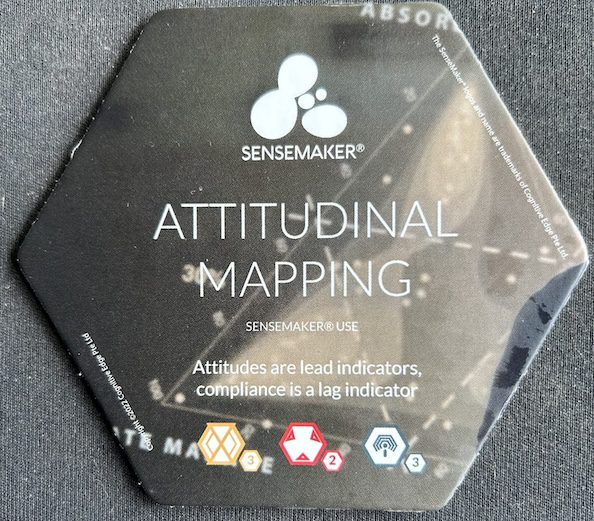
There is one hexi card that stands out to me more than the others. This hexi has challenged my work this year in many different ways, and it is prominently placed on my computer stand to remind me of the following:

“Attitudes are lead indicators, compliance is a lag indicator”.

Dave Snowden, Cynefin Co hexi kit, Attitudinal Mapping hexi

I hope I wont be in trouble for sharing the photo of this hexi below.

This hexi published by Cynefin Co has really challenged me throughout this year to think differently about noticing and enabling change.

With Dave’s permission, I often paraphrase this hexi in conversations about technological change or economic development-related work as follows: “Attitudes are lead indicators, evidence/data is a lag indicator”.

Those that know me would understand why this hexi is so profound to me.

Already, this specific hexi has shaped many of the commissions that I have taken on this year. It also helped me to turn down several projects.

  • For instance, it became the refrain in designing a Sensemaker Engagement for an international development project to track emerging signals of change over 12 Eastern European and Western Balkan countries.
  • This hexi-card also inspired our Mesopartner 20th anniversary Sensemaker project, where we scanned how economic development practitioners have engaged with and used our Mesopartner instruments over 20 years and how they observed changes unfolding in the development field.

One of the projects that I am leading is the Technological Change and Innovation System Observatory project hosted by TIPS in South Africa. The challenge we face in this project is captured by this same Hexi. Many companies are experimenting with or building their competencies in frontier technologies. The challenge is that these shifts of focus and investment do not yet show up in any reliable datasets (in fact, official data suggests that more investment in the same polices that have not been working are needed). In essence, the interest and focus of our innovators are shifting to capabilities that do not yet exist in domestically. Not only does this reduce the demand or throughput that is needed to make domestic technological competencies viable in the public and the private sectors. It also threatens to drive a bigger gap between those who have (new technology, new knowledge, new opportunities) and those who have not (old technology, conventional knowledge and mature markets) in an already highly unequal country. This hexi gave me the courage to shift from trying to find better data, to paying more attention to subtle changes that signals shifts in behaviour. It demands that we interact with the people that are using new knowledge in different ways, instead of trying to make sense of data. More about this in a later post.

A final remark about the impact of these kits and this particular hexi card on my year. These kits helped me to shift from a strong reliance on developing better diagnostic instruments (what is wrong, or what already happened, as captured by data and evidence) towards an emphasis on what is possible from where we are now, which tensions or contextual nuances can be explored for opportunities to innovate, or how innovations or new capabilities that have gone unnoticed can be amplified (or dampened). Already in this year I have been able to assist my clients to not diagnose that past, but to embrace the possibilities of change offered by the contexts they are immersed in.

***

The hexi-kits published by Cynefin co have really inspired my thinking. Cynefin co has taken collaborative approach and I am delighted to be part of the community of practitioners that are developing additional method packs.

Cynefin co are currently working on version 2 of their kits and I can hardly wait to see what they contain. For the last year I have been working in different collaborations to refine or create new hexi add on packs:

  • In July, we released a prototype of our Systemic Insight search and discovery hexi kit to participants of our Summer Academy held annually in Berlin. The featured image of this post is where we showed the participants how to use the Systemic Insight hexi kit.
  • We also released our Systemic Competitiveness cube prototype as part of our complex facilitation kit.

We are currently working on several additional kits that are all in different stages of development. Currently, I am working on:

  • A hexi add-on pack focused on the diagnosis and improvement of systems of innovation and learning. This kit draws on innovation system, evolutionary economics and new institutional economics to equip stakeholders to identify opportunities to strengthen the learning and innovation practices in an industry, region or around a set of knowledge domains.
  • A hexi add-on pack focused on local economic development (with Christian Schoen) drawing on our Mesopartner experience that will equip local collaborators to assess and identify improvement and innovation opportunities in a local economy.
  • A hexi add-on pack to diagnose and improve entrepreneurial innovation ecosystems that will equip innovators and network weavers in the private and the public sector to strengthen the interdependence and connections using an ecosystems approach.

I am also collaborating with others in the Cynefin Co network to develop hexi-packs on knowledge management, trust building and technological change.

Some of these ideas are still in their infancy, while others are already quite far advanced. I will only release the next kit after Cynefin release the next versions of their hexikits in the coming months.

In closing, have you been experimenting with these same methods? Are you getting different results as well, or do you also sense that you should shift from figuring out what happened to what is possible?

Let me know how it is going, perhaps we can exchange ideas going forward.

Disclaimer. I am not an employee of Cynefin co. However, I am a paying member of the Cynefin Co premium membership network. I wrote this post because I believe it is important to celebrate and acknowledge the profound effect that Dave’s ideas and methods have had on my praxis.

Where to focus next?

A few of my clients are preparing to wind down their manufacturing and engineering activities for the Christmas break. This is especially true for my clients in the Southern Hemisphere, where at least half of December is the holiday season. Clients with a retail business model are most likely now planning for the busiest time of the year.

My message today is mainly for the manufacturers heading for a slower season.

What have you ignored or pushed aside during the year because there were other priorities? Take some of these neglected issues and put them on the agenda for discussion with your team. These less-urgent issues could hold value in challenging your assumptions and maybe even your priorities.

These issues are lower priority until something goes wrong. If you could afford to ignore these issues up to now, the chances are that you will again ignore them in the new year. However, ignoring issues that matter to some of your clients or staff or that deserve attention, but there is none to give should simply get attention so that you are not caught off-guard.

So, let me try to rephrase my question.

What issue or topic have you ignored, postponed or delayed?

If addressed, which issues will release energy or build trust in your company?

Suppose you cannot explore these issues because you constantly have more important stuff to attend to. In that case, I urge you to delegate these to people you trust, especially if these issues are important to others in your company. Perhaps by giving somebody else a chance to lead on a matter they care about would boost their confidence and reveal new talent and passion in your organisation.

2023: The themes that I circled (Post 1).

I want to share the themes I have circled during the last year. Maybe I did more reflection than usual, as we have celebrated Mesopartner’s 20th anniversary this year.

Co-evolution is the first theme I have circled back to many times over the year. In the first half of the year, I tried to work through some of these ideas in different blog posts. The importance of understanding that in a co-evolution, changes in one element enable or demand changes in another. When we say that institutions, technologies, companies and places co-evolve, it implies that a new possibility or competence (or a constraint) in one dimension will shape what changes are possible in other areas. Or the interdependencies might resist lasting change.

Yet, in economic development, there is often a tendency to want to fix through a theme focused mainly on one dimension (think of projects targeting skills development, digitalisation, green or inclusion) without paying attention to the interdependence that makes systems return to some form of stability. This is the reason I keep on circling back to co-evolution.

In our approach in Mesopartner, we pay careful attention to how firms, their supporting institutions, places and technologies co-evolve. It is hard to achieve lasting positive change without considering how these different spheres affect each other. At the same time, co-evolution happens in a context with many different histories, and changes are also affected by the inherent interest of various stakeholders to respond to implicit or maybe explicit pressure in their context.

In July, at our Annual Summer Academy event held in Berlin, we illustrated co-evolution in an economy by presenting the Systemic Competitiveness framework in the shape of a cube, with the volume of the cube representing the interdependence between six sides.

The Systemic Competitiveness framework presented as an evolutionary system in the shape of a cube

I must admit that this explanation worked better than I ever expected (I have been playing with this idea already for a while). When presenting Systemic Competitiveness in our usual way (think of the rainbow map of Systemic Competitiveness), the co-evolutionary interdependencies are not so visible (see the images at the bottom of this post). Firms are in the bottom layer, specific supporting institutions in another layer, with generic macro policies on the third layer and the meta factors on top like icing on a cake. Further, illustrating these forces on the Systemic Competitiveness framework diagram with lines and arrows makes the approach look like a messy closed system diagram.

However, when we show people this cube, they can immediately look at one side to describe a situation, and then, as they turn it, they can look at the same situation from another dimension or angle. We then have to remind people that the space in the cube represents the dynamics or the co-evolution between the different sides.

There was another motivation for developing this cube as a physical object, which is about complex facilitation. Complex facilitation methods are about removing the bias, question framing or group steering of a group of people as they navigate or explore a given issue. As often is the case, Dave Snowden deeply impacted my facilitation praxis with his methods of complex facilitation. The launch of the brilliant Cynefin Hexi kits last year made a deep impression on me. As a side note, we have developed an add-on Hexi-pack pack for our clients, but I will write about that later.

Let me explain how the Sysco cube enables complex facilitation.

When using the Systemic Competitiveness Framework (in our conventional map approach) during fieldwork or workshops, we must facilitate conversations between stakeholders about where certain actors, organisations, functions or persistent patterns are on the Systemic Competitiveness map. People are often more focused on correctly classifying issues rather than exploring how different things may be connected or affecting/reinforcing each other. With the physical cube, people can now use the six sides and the space within it to explain persistent patterns they observe from different angles. They can then offer hypotheses of how the issues are related from the different perspectives described on the sides of the cube, or what they think can be tried to shape the observed patterns. The facilitator is no longer required to interpret and classify the issues raised during the discussion; their role is to urge people to add, disagree, challenge, connect and document what is being discussed. I have found that in most meetings, people immediately understand the interconnectivity between the cube’s six sides. The conversation is no longer about where an issue should be categorised but how it relates to other factors.

I must add that now that I have thought through co-evolution in the Systemic Competitiveness framework with the cube, I have even invoked this image during meetings where I did not have the cube physically with me. Even without the cube present, people have understood the implications of what I explained.

To frame the significance of this method in another way. I have shifted Systemic Competitiveness from a taxonomy system to a typology, where we can look at the same socio-economic system from different yet related dimensions. Where the interconnections and dynamics were often an afterthought of the mapping process, it is now literally central to the conversation.

Below are the images showing the layers of Systemic Competitiveness we have been using in the past.

Working in between domains and contexts

As we celebrate the 20th anniversary of Mesopartner this year, we have been reflecting with each other and some close collaborators about our role in development. It has been a gratifying and humbling experience to hear what others think about our role (as Mesopartner) and how they reflect on their roles. Some of my friends, who were previously clients or colleagues, also reflecting on their changing roles as they shift from fieldwork to management or from one country to another.

One theme that has crystallised for me is that we often work between contexts in economic development. We connect local energy with ideas from far away, try to bridge the gap between the private and public sectors, foster feedback between interventions and beneficiaries, and connect ideas and domains that should be connected but are not. Even when we work in a large development organisation, we often work to identify and close gaps that we detect in the environments that we work in. Our focus is beyond and between organisations and not within. Building our team, our brand, or achieving our direct results is secondary to building the confidence and the capabilities of those that we call “counterparts”, “stakeholders”, or “beneficiaries”.

You might wonder why I think this is even worth sharing. This is such an obvious statement about development. Well, I think this is important to ponder because so many of the management instruments used in development originate in the corporate sector, where in theory, everyone is working in the same organisation towards the same goals. Just think of measurement instruments, planning methods or knowledge management. These concepts often assume that everyone is in the same boat heading towards the same shore.

But this is not true in economic development. When we try to get the private and the public sector to cooperate, they might now temporarily share a boat, but this is not likely their preferred means of getting to a destination. One might prefer a windsurf or a sailboat, while the other might prefer a cargo ship. We work between these domains and preferences, so our methods, logic and management approaches should reflect this “in-betweenness”. Suppose we want anything to stick or be taken up by anybody we work with. In that case, our methods must add value to their organisation’s goals and complement the kind of natural skills, resources and internal systems they have in place. Whenever we ask them to take up something that is not aligned or natural to how they usually work, we should not be surprised if, in the longer run, our ideas are not taken further.

As I have been reflecting on this for a few months, I have evaluated which of our instruments are temporary or specific and which ideas and concepts can be taken up and used in many different contexts. (I will shortly write about the Sensemaker survey that we used to collect narrative fragments of how our work in development matters and is changing). The way we facilitate conversations between stakeholders seems to have more value than the actual constructs we use to gather information or support decision-making. Perhaps the fact that we actively strive to get people together that usually move in different orbits also stands out. Some other ideas that stand out are the importance of creating moments in teams or even in temporary collaborations for people to stand back (from action) to reflect on where they are going, and whether whatever they are doing is having the desired effects.

Often the principles and the heuristics that we use have more value in the long run and different contexts than the methods or approaches we use. However, principles and heuristics are only transferred to the people we work with when used or applied in a specific context. Going forward, I will be paying more attention to the heuristics and principles that are valuable in the in-between contexts. I will also pay more attention to making it explicit how the ideas we work with can be adapted for different contexts and applications so that what works “in-between” can also be used to improve how things work within organisations.

Mesopartner’s 20th anniversary celebration in Berlin

On Friday the 7th, we celebrated Mesopartner’s 20th anniversary in Berlin.

Finally, the day we had planned for months had arrived. We were joined by many friends and collaborators who could travel to Berlin to join us, and well-wishes streamed in from all over. The venue was our favorite Hotel Grenzfall, where we hosted our Summer Academy in the preceding days.

Thankfully, Ulli had something to say when Natasha surprised us with “Say something”

Natasha Walker moderated our programme with her usual energy and grace. This meant we could all participate in the programme with our guests.

Annelien shared a video she and Britta (our resident photographer) had prepared using our favourite photos collected over 20 years. You should watch it if you have not already seen it.

You should watch the video! Click on it!

Die Gorillas, an improvisation theatre group, collected sentences and words from the audience about what it is like to work with Mesopartner. They then used these words and lines as impulses in their theatre performance. We were all in stitches! Seeing how they twisted and interpreted the jargon and phrases we use all the time was so funny.

Saying any of the following phrases would get any of our guests giggling: “competetitititiveness!”, “collaborate, collaborate, collaborate“, “bottom-up” and “we are pirates saving the world“.

During our celebrations, we also took an hour to reflect on “What matters now?” using a warm data lab format. This was an excellent way for us to reflect in more intimate groups about essential issues confronting all of us. I participated in discussions about spirituality, science, ecology and art. We held this in the lovely garden of the Hotel Grenzfall.

The warm data lab in the garden of the Hotel Grenzfall

The formal programme ended with more improvisation theatre, where we shifted our attention to food, drink and laughter until the early hours of Saturday morning.

This was a special event for me. Whoever thought that a guy from the Freestate Province in South Africa could one day be part of such a remarkable company and network? Who thought our small multinational microenterprise would have such an amazing network of friends, and collaborators all working to improve how economic development is done around the world?

For me, it is all the grace of God.

Thank you to everyone that joined, sent their wishes, or toasted our 20th anniversary with us!

To everybody who could not join us, but wanted to, we say “Cheers!”

Thank you Zdravko for traveling all the way to join our celebrations. You are a mentor and inspiration to us all.