This is one of my favourite topics to write, read and talk about. How knowledge can be leveraged to enable innovation in organisations. Even if it is tacit, or people don’t even know they posses valuable knowledge, leaders can create an environment where these ideas can be surfaced, explored and leveraged.
The pdf here contains three revised blog posts that I wrote on my ‘thinking out loud‘ blog site over the last two years. I’ve had the text edited and have made some improvements. Take a look and let me know if you find this useful.
For the last four years I have been working on this idea of catalysing or instigating innovation (take a look at my “thinking out loud blog“). It is about what leaders at different points in organisations or networks can do to improve their systems, products, environments and structures.
Central to innovation is the generation, recognition and exploration of knowledge. This knowledge can be trapped in the minds of individual staff, customers, suppliers or users, or it can be explicit. It can be latent, or it can be in your face but not used.
Another central pillar to innovation is dialogue. By this I mean not just a conversation, nor do I mean communication systems. I mean an ongoing and ever expanding process of change through dialogue – the exchange of ideas, the exploration of concepts, the identification of mental maps, attractors and emergent properties, the breaking down of aggregates and boundaries and the construction of new concepts. Dialogue spans many levels, it functions throughout the organisation and even spills over the boundaries of the organisation into other organisations, cultures, systems and networks.
By combining our research in Mesopartner on complexity and evolutionary thinking, and our experience and practice in promoting innovation within and between organisations, I came up with four frames to instigate innovation.
I describe the four frames in more detail below the diagram. In the diagram the activities are on the left hand side, and the documented strategies and how they are connected are on the right side. You have the read this diagram from the bottom up.
The Instigating Innovation Framework
The first frame is about the interaction between the strategy of the organisation, the business, the unit or the team and the innovation strategy. Many organisations have a business strategy and then a separate innovation strategy. Or they have only a business plan used mainly for financial reasons, and do not spend sufficient time tracking technological change, market change and new paradigms. Ideally the business strategy and the innovation strategy should be tightly interwoven, with the one strongly shaping the other. The more your team innovates in products, processes and business structures, the more innovative your business strategy will be.
The second frame is about how the organisation recognises, generates and leverages knowledge. This is about creating new organisational and personal habits about generating, testing, combining and stretching the use of knowledge. It enables organisations to become more thoughtful, more intentional about learning, exploring and the leveraging of knowledge to become far more innovative. In this this frame the organisation activates its resources and systems to become more knowledge intensive. The result of this frame is a knowledge, dialogue and learning strategy that feeds into the innovation strategy outlined under the first frame.
The third frame is about developing a portfolio of improvement activities that spans different time horizons, technologies, markets and functions. Many companies already have improvement activities, but because the first two frames are not in place, these projects are often isolated, project driven and to some extent even disruptive. Every opportunity to change something small, to replace something, to move something or to install something should be an opportunity to strengthen the cultural traits that are healthy, and to dampen the organisational habits that are not supporting the business strategy. From this frame we develop operational and functional or unit-level strategies that operationalise and feed back into the two earlier strategies.
The fourth frame is about networks that connects the inside of the organisation with broader knowledge, technology and societal networks. It is about developing and strengthening the knowledge networks and flows within the organisation and to external organisations. Here the organisation intentionally builds the technological capability of external knowledge partners. It is from here that the organisation can support research and development and longer-term scientific thinking. Here the organisation also purposefully engage in trans and multidisciplinary research, where the thinking and knowledge base of the organisation gets stretched. From this frame we develop a network and research strategy that feeds into the earlier strategies.
Over the years I have assisted many organisations to embark on this journey. I have seen at first hand how organisations and teams that have purposefully improved the way they talk to each other have shifted from being followers to becoming innovative leaders. I have seen the power of simple frameworks that allow deep reflection on perspectives, a continuous process of a calibration of ideas that are mixed, re-mixed and tried. I have also seen how managers at all levels and individuals grow in confidence as they feel more acknowledged, valued and fulfilled.
I hope you will take your team on this journey!
There is a subscription button on the right of this blog page if you want to receive two updates a month on how you can unleash the creativity of your organisation.
In 2016 I wrote an article for the University of Stellenbosch Business Schools Thought Thursdays newsletter about how leaders can unlock knowledge intheir organisations to enable innovation. This article has lead to many
interesting presentations, speeches and conversations. I also wrote several follow on articles on the cunningham.org.za that can all be accessed from this link.
In the USB article I wrote that leaders must incentivise and encourage staff to accumulate knowledge through deduction and experimentation, as well as reaching beyond their organisation. This would require that staff are encouraged to invest time in reading, exploring and trying out new ideas. Learning by doing should be encouraged, and tacit knowledge should be actively sought out and leveraged.
For the readers of this blog I think that article is a good starting point to reflect on the culture of acknowledging and encouraging knowledge creation in your organisation. It is not so important to try and formalise all knowledge as it is to actively encourage employees to actively seek out what they know and to experiment with how this knowledge can be used, recombined and leveraged.
Originally published in August 2015, revised in January 2018
I received many comments and tweets about the previous post. Thank you for ideas and comments
Some agreed that innovation is the result of culture. Some said that culture is not only created by management, but also by staff. For instance, the admin pool in a traditional engineering company can be very innovative (and creative) even if the rest of the business is stuck in the 1980s.
Somebody told me that creating an innovative culture is in itself a chicken-egg (low equilibrium) situation, because for a leader to create (or enable) an innovative culture takes innovation in itself. You can see where this is going.
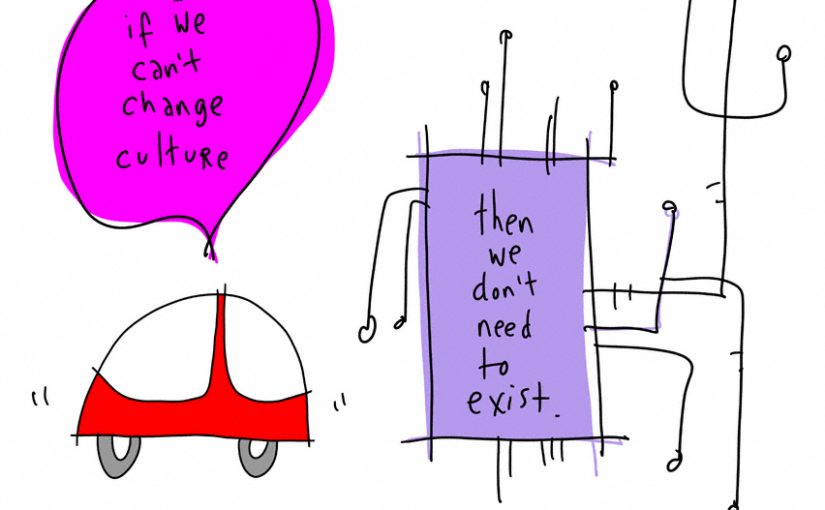
Then I discovered a recent cartoon in my inbox by Hugh Macleod of Gapingvoid fame. This cartoon says it all.
An organization that cannot change its culture (due to too rigid systems, due to lack of management capability, due to its people) has become trapped in time. While some organizations may exist like this due to sheer momentum, due to protection (by law), by continuous funding, or for whatever reason, will struggle to adapt to external change. These organizations are not resilient and they are at the mercy of external supporters (a.k.a clients, benefactors, funders or shareholders).
I was also asked how some organizations can still innovative despite a poor innovation culture. Again, it is of course possible to replace a machine, or for a few people in an organization to design something brilliant, or for a new process to emerge. Of course it is possible. But it takes much more energy, determination of a few, and some really tenacity to be innovative in an un-innovative (what is the right word here?) culture.
I am sure more comments will come.
Cheers, Shawn
I appreciated the comments received by e-mail, but wonder why people are not posting comments to this article? Is the WordPress registration process to difficult? Please let me know. And keep those comments coming!