
Leaders who ask this often turn the lens on themselves. They sense that their own push for stability and structure has squeezed out the exploratory energy. That instinct is partly right. But the obvious response (reaching for an innovation method, announcing a change in culture, or launching a new strategic vision) usually makes things worse.
Any bookshop’s business section has no shortage of self-help innovation books. The problem is not access to recipes. When you choose the method, you send the wrong signal: the leader innovates, the people implement. An innovation culture is something different. It is one where an employee can say to another, “This is not working, and we need to figure out how to improve it.” That is what you are trying to build. Announcing an initiative does the opposite. It shifts attention to the leader’s vision rather than to the people who already see what needs to change.
Don’t announce innovation. Model innovation
Start by asking a few teams or individuals, without much ceremony: “If you could invest time, money, or people in any area of this organisation right now, where would you want to explore?”
I often ask teams, “If the limited attention and resources could be represented by 500 monopoly dollars, where would you allocate them if you could prioritise an improvement or exploration activity?” It is interesting to see where they put the $1s and the $100s.
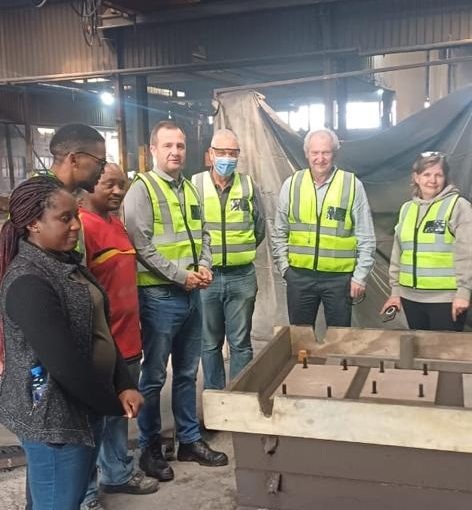
A young general manager at a metal manufacturing plant in South Africa inherited a position nobody wanted. The plant’s international owner had already listed it as underperforming and marked it for closure.
He gave his staff a budget of 1,500 Euro and one question: what is the one thing worth improving? They argued. They debated. Eventually, they agreed on three: the parking lot and damaged shade structures, the toilets and wash basins, and safety barriers around an industrial robot where injuries kept happening. He approved all three.
That argument was the point. Within 18 months, the habit of debating what needed to change and how to measure the change had taken hold. Line managers now carry a budget for improvements that their staff had identified. The mother plant in Germany started routing its smaller, more complex jobs to South Africa. Faster turnaround, better price, better quality than anywhere else in the group.
That exchange is what the Monopoly money question is trying to recreate.
That question about how to allocate the money does several things at once. It signals trust. It creates space for people who already see opportunities but haven’t been asked. It starts a conversation about priorities rather than compliance. Most leaders are surprised by how mindful their teams are when allocating scarce resources.
Many leaders I work with resist this. They worry their teams will prioritise the wrong things, or chase ideas that go nowhere. That fear usually says more about the management culture than about the people. In my experience, teams do not abuse the space when managers mean it. Asking teams to prototype or simulate before committing further reduces the risk. A budget cap of a few hundred dollars, a thousand at most, keeps individual experiments low-stakes. Overworked management is often a self-inflicted problem.
When someone responds with a suggestion or a priority area for innovation, agree together on a modest budget, a time frame, what resources they’ll need, and how you’ll track whether the effort is going somewhere useful. Then step back from the content. Your job shifts to the systems around the team. Finance needs to release a small budget without a full business case. HR needs to allow time for work outside the normal job description. Communications and operations need to know something unusual is happening and not treat it as a problem. This is where most innovation efforts quietly die. The people doing the exploring can handle uncertainty. The administrative systems usually can’t.
One more condition matter: the results need to be visible. Open measurement keeps experiments honest without the leader having to police them. People do not pursue detached ideas when they know the results will be seen. But visibility only works if management holds up its side. When results are promising, more resources must follow. That compact, transparency in exchange for amplification, is what turns a portfolio of small probes into a real learning system.
Portfolios, not bets
A single experiment is closer to a casino bet than a learning strategy. You either win or lose, but you don’t learn much about the system either way. Dave Snowden’s work on complexity makes a useful distinction here: in uncertain conditions, design portfolios of small safe-to-fail probes that can be implemented in parallel. Each one is low stakes enough that failure doesn’t punish the team; it informs them. As a portfolio, they distinguish real constraints from untested assumptions. The experiments show where there is more room than anyone expected.
Encourage the team to run several small experiments at the same time, rather than betting everything on one initiative they then must defend. Build in regular reflection. Put more behind the experiments showing promising results; wind down the ones heading in the wrong direction without drama and take the learning.
Keep the group small. Large teams make failure visible in a way that stops people from trying, which kills the exploration you’re trying to encourage. Once one group has found its footing, encourage another team in a different part of the organisation to identify their own area of exploration.
Your actual job. Hold a space for your people to try things
Here is the harder point. When organisations stop innovating, the most common cause is not a shortage of ideas or talent. It is too much management: specifically, the structures and procedures built to create stability that have gradually become rigid. The same routines that once made things reliable now make things slow. The innovators need protecting from those systems, not from uncertainty.
Your role is not to relax standards or abolish procedures. It is to make sure the support functions are evaluating their own practices against the actual needs of the team and changing where needed. Let them do that assessment themselves rather than defending the status quo. Protect the people exploring. Keep the risk low by insisting that all experiments are small-scale and reversible.
None of what I’ve described is the standard image of an innovative leader. The job here is different: to make sure the rest of the organisation is working for the people doing the exploring, not against them. Be the conductor, not the lead instrument.
After some time doing this, the innovation recipe books will have more to offer. The tools work better once your people have developed the habit of noticing what needs to change and doing something about it. That habit does not come from an announcement or a method. It comes from a leader who clears the path and gets out of the way.
I published the original version of this blog almost five years ago. This version is rewritten and updated and now includes an example.
Photo Credit: This photo was taken in 2023 during a visit to a foundry managed by Dalmari McQueen. In the photo, one of her team members is explaining to us how they tried something new in their mould preparation and how they measured whether this resulted in a higher-quality casting.